
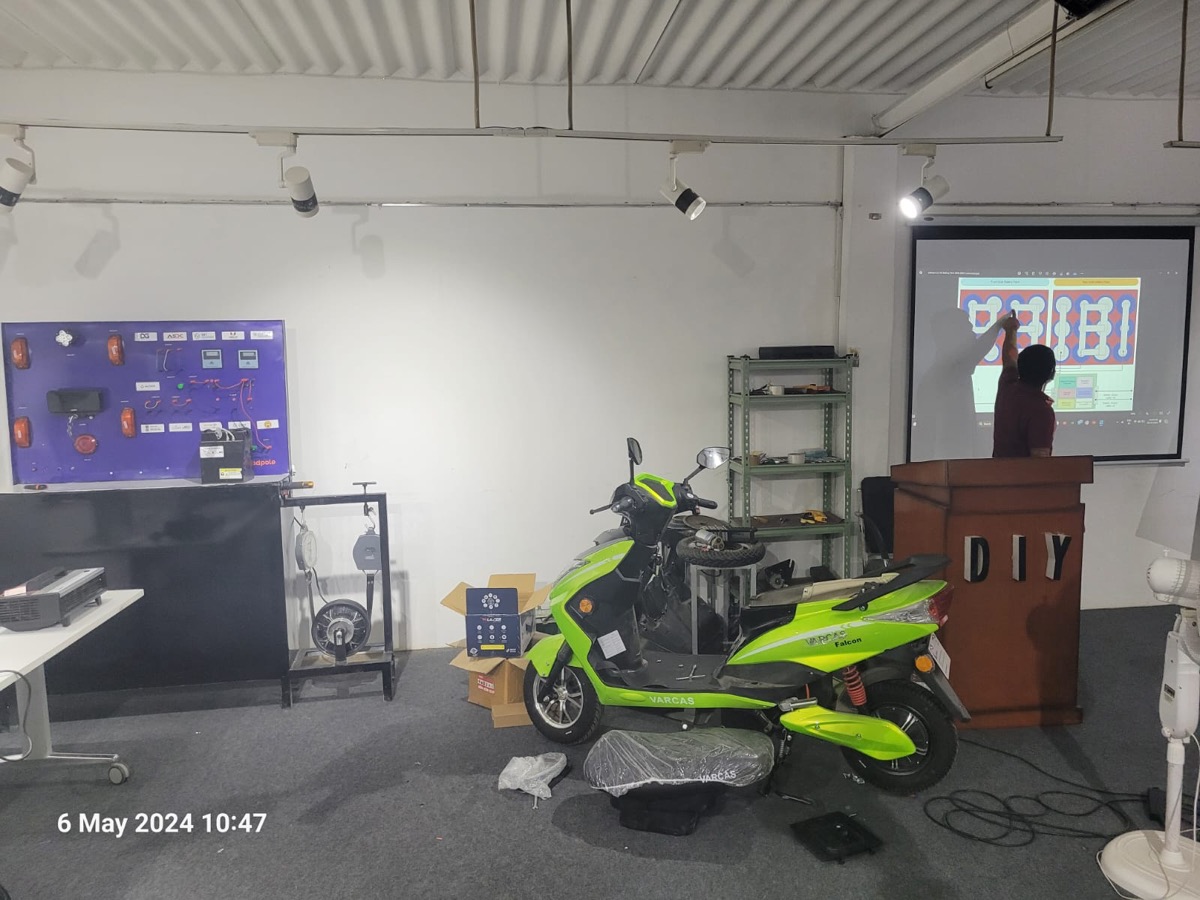
Step-by-step, from DIYguru's EV lab
100 EV Hacks You Can DIY: Battery, Charging, Range & Maintenance
Fix the everyday problems yourself: a charger that won't charge, a jerky throttle, a melted connector, lost range, monsoon water. Learn the tools, build your own test gear and keep your EV safe. Every hack lists the tools, the steps, the warnings and when to hand over to a technician.
Low-voltage, legal and reversible only. No opening battery packs, no high-voltage car systems, no speed or power unlocking.
Want to learn EV repair properly?
Tell us what you want to learn. Our team replies with hands-on workshop and course options.
The hacks
Find the fix you need
Filter by area, who it's for and risk. Open any hack for the full step-by-step guide.
- Battery careEasyTake care
1.Store an E-Scooter or E-Bike Battery for Months Without Damaging It
Prepare an electric scooter or e-bike battery for weeks or months of storage so it comes back healthy. You set a sensible charge level, switch off parasitic loads, store it somewhere cool and dry, and check it on a simple monthly routine.
20 minutesEV owners - Battery careEasyTake care
2.Check Your Battery's Health with a Multimeter
Use a digital multimeter at the battery's external connector to check resting voltage and how well the pack holds charge. You get a simple, repeatable health snapshot without opening anything.
30 minutesEV owners · Students · Makers - Battery careEasyLow risk
3.Read a Battery Label: Volts, Ah, Wh and C-Rate Explained
Learn to read the numbers on an EV battery label: voltage, amp-hours, watt-hours, C-rate, chemistry and IP rating. You will be able to compare batteries properly and estimate range from the label alone.
15 minutesEV owners · Students - Battery careModerateLow risk
4.Measure Your Battery's Real Capacity on a Test Ride
Run a controlled test ride and a measured recharge to estimate how much usable energy your battery really delivers. You get a real-world kWh and Wh/km figure to compare with the spec and to track ageing.
1 ride + 30 minutesEV owners · Students - Battery careEasyLow risk
5.Let the BMS Balance Your Pack: The Full-Charge Habit
Build a simple habit of occasionally charging fully and leaving the charger on until it finishes, so the battery management system can balance the cells. It helps keep the gauge accurate and the pack using its full capacity.
One overnight chargeEV owners - Battery careEasyTake care
6.Spot a Swelling or Failing Battery and Know When to Retire It
Learn the warning signs of a swelling or failing lithium battery and what to do safely when you see them. You get a quick visual and behavioural check and a clear plan for retiring a pack.
10 minutesEV owners - Battery careEasyLow risk
7.Battery Care Through Indian Summers and the Monsoon
Adapt your parking, charging and riding to Indian summer heat and the monsoon. You get a seasonal routine that protects the battery from overheating and keeps water away from electrical parts.
15 minutesEV owners - Battery careEasyTake care
8.Find a Hot Battery Connector with an Infrared Thermometer
Use an infrared thermometer to find a battery or charging connector that is running hotter than it should. You catch loose or corroded connections early, before they melt or cause a fire.
20 minutesEV owners · Students · Makers - Battery careEasyLow risk
9.Daily Charging Habits That Make Your Battery Last Longer
Adopt a few everyday charging habits that reduce battery stress and keep charging safe at home. You get a simple routine for when, where and how much to charge.
10 minutesEV owners - Battery careEasyLow risk
10.Keep a Battery Health Log in a Spreadsheet
Set up a simple spreadsheet to record charges, rides and battery readings. Over a few months it shows how your battery is ageing and flags problems early.
30 minutesEV owners · Students - ChargingEasyTake care
11.Charger Light Stays Red or Green? Troubleshoot It Step by Step
Work through the common reasons a two-wheeler charger light stays red, turns green too soon or does not light at all. You check the socket, plugs, temperature and vehicle settings from the outside and know when the fault needs a service centre.
30 minutesEV owners - ChargingModerateTake care
12.Test Your EV Charger's Output Voltage with a Multimeter
Measure your EV charger's output voltage at its output plug with a digital multimeter, without opening the charger. You find out whether the charger is producing roughly the voltage on its label.
20 minutesEV owners · Students · Makers - ChargingEasyTake care
13.Check Your Home Socket Before You Charge an EV
Check that the wall socket you use for EV charging is in good condition and appears correctly wired and earthed, using a plug-in socket tester and a careful visual check. You learn what to look for and when to call a licensed electrician.
15 minutesEV owners - ChargingEasyLow risk
14.Stop Charging at About 80% with a Smart Plug Timer
Use a suitably rated smart plug or plug-in timer to stop charging at roughly 80 percent on days you do not need a full battery. You work out the timing from your own charge log and still let the BMS do its job.
30 minutesEV owners · Students · Makers - ChargingEasyLow risk
15.Work Out Your Real Charging Cost per Kilometre
Calculate how much it really costs you to ride each kilometre on electricity, using your electricity bill and your own riding data. You get a figure you can compare with petrol, public charging or another EV.
20 minutesEV owners · Students - ChargingEasyLow risk
16.Measure How Much Energy a Charge Uses with a Plug-In Energy Meter
Use a plug-in energy meter between the wall socket and your charger to measure exactly how much energy each charge uses, plus power draw and charging time. You get accurate figures for cost, efficiency and spotting charger or battery changes.
One chargeEV owners · Students · Makers - ChargingEasyTake care
17.Clean and Protect a Corroded Charging Port
Clean dirt and light corrosion from your EV's charging port and charger plug, then protect it against moisture. Done with everything switched off and unplugged, it restores a good connection and reduces heating at the contacts.
20 minutesEV owners - ChargingEasyTake care
18.Choosing a Safe Extension Lead for Two-Wheeler Charging
Learn when an extension lead is acceptable for charging an electric two-wheeler and how to choose and use one safely. The best option is always a suitable wall socket; if you must use a lead, these rules reduce the risk of overheating.
10 minutesEV owners - ChargingEasyTake care
19.Charger Getting Hot or Noisy? What Is Normal and What Is Not
Learn what heat and noise are normal for an EV charger and which signs mean it should be switched off and checked. You also set up the charger so it can cool itself properly.
15 minutesEV owners - ChargingEasyLow risk
20.Plan a Longer EV Trip Around Public Charging
Plan a longer trip on an electric scooter or car using public charging, with realistic range figures, backup options and a buffer. You arrive with charge to spare instead of hunting for a working charger.
30 minutesEV owners - Motor & controllerModerateTake care
21.Hub Motor Won't Spin? A Step-by-Step Diagnosis
Work through a dead hub motor in a fixed order: battery output, fuses, key and kill switches, brake cut-offs, throttle, connectors and Hall sensors. You will either find a simple fault you can fix or know exactly what to tell the service centre.
1 hourEV owners · Students · Makers - Motor & controllerModerateTake care
22.Test Hub Motor Hall Sensors with a Multimeter
Check the three Hall sensors inside a hub motor from the outside by powering them from a current-limited 5 V supply and watching each signal switch as you turn the wheel. You will know whether the sensors are healthy without opening the motor.
45 minutesMakers · Students - Motor & controllerModerateTake care
23.Test a Throttle with a Multimeter and Fix a Dead Throttle
Measure a Hall-effect throttle's supply and signal voltages at its connector to find out whether a dead throttle is the throttle itself, its wiring or the controller. Then fix the simple causes: connectors, chafed wires or a like-for-like replacement.
30 minutesEV owners · Students · Makers - Motor & controllerModerateTake care
24.Fix a Jerky or Surging Throttle
Track down why your EV surges, jerks or hesitates when you open the throttle, from loose connectors and chafed wires to a worn throttle, voltage sag or a sticky brake switch. You will fix the simple causes and know when the controller needs a technician.
45 minutesEV owners - Motor & controllerEasyTake care
25.Test the Brake Cut-Off Switches That Stop the Motor
Check that each brake lever's cut-off switch tells the controller to stop driving the motor, using a stand test and a simple continuity or voltage check. You will confirm a vital safety system works and find faulty switches before they cause trouble.
20 minutesEV owners · Students · Makers - Motor & controllerEasyLow risk
26.Read Your Controller's Error or Blink Codes
Learn to read and record your controller's error codes or blink patterns from the display or a status LED, and match them to the manual. You will understand what the vehicle is telling you and give the service centre a precise fault report.
20 minutesEV owners - Motor & controllerModerateTake care
27.Clicking, Grinding or Whining Motor? Find the Cause
Identify whether a clicking, grinding or whining noise comes from the motor, wheel bearings, brakes, tyre or bodywork using simple listening and spin tests. You will fix the easy causes and know when the hub motor needs a workshop.
45 minutesEV owners - Motor & controllerEasyLow risk
28.Check Motor and Controller Temperature After a Hard Ride
Use an infrared thermometer after rides to record motor, controller and battery-case temperatures and build your own normal baseline. You will spot overheating early and learn which riding habits make components run hot.
15 minutesEV owners · Students · Makers - Motor & controllerEasyLow risk
29.Understand Controller Current Rating vs Motor Power
Understand how battery voltage, controller current limit and motor power rating relate, and why the motor's rated power is not the same as peak power. You will read spec sheets correctly and see why mismatched or upgraded controllers cause problems.
20 minutesStudents - Motor & controllerModerateTake care
30.Mount and Ventilate a Controller So It Doesn't Overheat
Mount a motor controller in your own e-bike build or bench project so it sheds heat, stays dry and is protected from vibration. You will get cooler, more reliable operation and fewer over-temperature cut-outs.
1 hourMakers · Students - Wiring & connectorsEasyTake care
31.Crimp and Heat-Shrink Connectors the Right Way
Make reliable crimped joints on low-voltage EV wiring with the right terminal, the right crimp tool and adhesive-lined heat-shrink. You will get connections that survive vibration and monsoon rain instead of loosening or corroding.
30 minutesEV owners · Students · Makers - Wiring & connectorsModerateTake care
32.Replace a Melted XT60 or Anderson Connector on a Low-Voltage Lead
Replace a melted or loose XT60 or Anderson-style connector on a low-voltage lead you can fully disconnect, such as a controller, accessory or bench project lead. You will also find out why it melted so the new one does not fail the same way.
45 minutesMakers · Students - Wiring & connectorsModerateTake care
33.Find a Short Circuit with a Continuity Test
Track down a short circuit in a low-voltage accessory or signal circuit by measuring resistance with everything de-energised and splitting the wiring into sections. You will find the exact chafed wire or failed part instead of guessing.
1 hourEV owners · Students · Makers - Wiring & connectorsEasyTake care
34.Find an Intermittent Fault with a Wiggle Test
Find a fault that comes and goes, such as a flickering light or a cut-out over bumps, by watching a meter while gently flexing wiring and connectors section by section. You will locate the loose pin or cracked wire that ordinary tests miss.
30 minutesEV owners · Students · Makers - Wiring & connectorsEasyLow risk
35.Draw Your EV's Wiring Diagram Before You Touch Anything
Map your EV's visible wiring into a simple diagram with photos, connector notes and colour codes before you change or repair anything. You will have a reference that makes faults faster to find and reassembly mistakes far less likely.
1–2 hoursEV owners · Students - Wiring & connectorsEasyLow risk
36.Use Dielectric Grease to Stop Connector Corrosion
Protect your EV's low-voltage connectors from moisture and corrosion by cleaning them and applying dielectric grease to the seals and housings. You will cut down rain-related faults and make connectors easier to unplug later.
20 minutesEV owners - Wiring & connectorsEasyLow risk
37.Choose the Right Wire Size for the Current
Pick the right wire size for a low-voltage EV accessory or maker circuit by working out the current, the fuse rating, the allowed voltage drop and the wire maker's rating. You will avoid hot, undersized wires and dim, under-powered accessories.
20 minutesMakers · Students - Wiring & connectorsEasyLow risk
38.Solder or Crimp? When to Use Which on an EV
Learn when soldering is the right joint and when crimping is better on an EV or maker project, based on vibration, current, serviceability and the connector's design. You will choose joints that last instead of ones that crack or loosen.
15 minutesMakers · Students - Wiring & connectorsModerateTake care
39.Add an Inline Fuse to a Low-Voltage Accessory Circuit
Protect a new low-voltage accessory, such as an extra light or USB charger, with a correctly rated inline fuse fitted at the supply end. You will make sure a fault blows a fuse instead of melting wires.
45 minutesMakers · Students - Wiring & connectorsEasyLow risk
40.Route and Label Cables So They Don't Chafe or Get Confused
Re-route, secure and label your EV's visible low-voltage cables so they cannot rub through, get pinched by the steering or be confused during repairs. You will prevent a whole class of shorts and intermittent faults.
1 hourEV owners · Students · Makers - Range & efficiencyEasyLow risk
41.Get More Range with the Right Tyre Pressure
Check and set your EV's tyre pressure cold, to the figure printed in the owner's manual or on the frame sticker. You get lower rolling resistance, steadier handling and more even tyre wear, all of which help range.
10 minutesEV owners - Range & efficiencyEasyLow risk
42.Riding Habits That Noticeably Extend EV Range
Change a few riding habits for one week, smooth starts, steady cruising, earlier lifting off and sensible use of ride modes, and compare your range before and after. You get more kilometres per charge without touching any hardware.
One week of ridesEV owners - Range & efficiencyEasyLow risk
43.Measure Your Real Wh/km and Compare It with the Spec
Measure how many watt-hours your EV really uses per kilometre, using the battery's rated capacity, your state-of-charge readings and a home energy meter on the charger. You get a real efficiency figure to compare with the spec and track over time.
One ride + 20 minutesEV owners · Students - Range & efficiencyEasyLow risk
44.Check for Brake Drag That Quietly Eats Your Range
Check whether a brake pad, drum shoe or caliper is rubbing on the wheel, using a spin test, a feel test and an infrared thermometer. You find hidden drag that wastes energy and wears brakes.
15 minutesEV owners - Range & efficiencyEasyLow risk
45.Use Regenerative Braking Effectively
Learn how your EV's regenerative braking works and adjust your riding to use it well: earlier lift-off, the right regen level, and smooth blending with the friction brakes. You recover some energy and save brake pads.
One week of ridesEV owners - Range & efficiencyEasyLow risk
46.Reduce Weight and Drag on an Electric Two-Wheeler
Clear out unneeded weight, rethink luggage and accessories, and adjust your riding posture to cut air drag on an electric two-wheeler. You get small but real range gains with no modification to the vehicle's electrics.
30 minutesEV owners - Range & efficiencyEasyLow risk
47.Plan Routes Around Climbs and Traffic for Better Range
Use a map's terrain and traffic views to choose routes that avoid steep climbs and long stop-start stretches, and plan a safe buffer for long trips. You arrive with more charge and less range anxiety.
20 minutesEV owners - Range & efficiencyModerateLow risk
48.Check Wheel Alignment and Bearings for Rolling Resistance
Check that your scooter's wheels are aligned and that the wheel bearings spin smoothly without play. You find hidden rolling resistance and wear before it becomes a safety problem.
30 minutesEV owners - Range & efficiencyEasyLow risk
49.Keep a Range Log and Find What Really Affects Your Range
Keep a simple ride-by-ride log for a month and use a spreadsheet to see what really changes your range: speed, mode, load, weather or tyre pressure. You replace guesses with your own evidence.
30 minutesEV owners · Students - Range & efficiencyEasyLow risk
50.Use AC and Accessories in an Electric Car Without Losing Much Range
Use your electric car's climate control, pre-conditioning and accessories in a range-friendly way, using only the car's own settings and app. You stay comfortable while keeping range loss small.
15 minutesEV owners - MaintenanceEasyLow risk
51.A 15-Minute Monthly Check-Up for Your Electric Two-Wheeler
Run a 15-minute monthly check of tyres, brakes, lights, fasteners, cables, the charge port and the charger on your electric two-wheeler. You catch small problems early and keep the vehicle safe and efficient.
15 minutesEV owners - MaintenanceEasyLow risk
52.Wash an Electric Scooter Without Water Damage
Wash your electric scooter safely with a bucket, gentle low-pressure rinse and microfibre cloths, keeping water away from the charge port, display and connectors. You get a clean scooter without water getting into the electrics.
30 minutesEV owners - MaintenanceModerateTake care
53.Monsoon-Proof Your EV's Connectors and Controller
Prepare your EV's accessible low-voltage connectors, charge port and cable routing for the monsoon using dielectric grease, proper covers and drainage checks. You reduce corrosion and water-related faults during the rainy season.
1 hourEV owners - MaintenanceModerateLow risk
54.Adjust Disc Brakes and Bed In New Pads
Centre a rubbing disc brake caliper and bed in new pads with a series of controlled stops in a safe place. You get quiet brakes, full braking power and even pad wear.
45 minutesEV owners - MaintenanceModerateLow risk
55.Inspect and Replace Brake Pads on an E-Scooter
Measure the remaining brake pad material on your e-scooter and, if your model and skill allow, fit new pads of the correct type. You keep braking reliable and protect the discs from metal-on-metal damage.
45 minutesEV owners - MaintenanceModerateLow risk
56.Check and Adjust Loose Steering Head Bearings
Check your scooter's steering head bearings for looseness or notchiness and, where your model allows, adjust them to the correct preload. You get stable, precise steering and avoid wobbles under braking.
45 minutesEV owners - MaintenanceEasyLow risk
57.Clean and Lubricate a Folding E-Scooter Mechanism
Clean, inspect and lubricate the folding joint and latch on a folding electric kick scooter. You get a smooth, rattle-free fold and a latch that locks securely every time.
30 minutesEV owners - MaintenanceEasyLow risk
58.Inspect Suspension Forks and Shocks
Inspect your EV's front fork and rear shock for leaks, play, damage and correct movement, and keep the seals clean. You get a smoother ride, better grip and earlier warning of suspension wear.
20 minutesEV owners - MaintenanceEasyLow risk
59.Prevent and Treat Rust on an EV Frame and Fasteners
Find and treat surface rust on your EV's frame, stands and fasteners, and protect them before the monsoon. You stop corrosion spreading and keep bolts removable for future servicing.
1 hourEV owners - MaintenanceModerateLow risk
60.Repair a Tubeless Tyre Puncture on an E-Scooter
Find and plug a tread puncture in a tubeless e-scooter tyre with a standard plug kit, then reinflate and check for leaks. You get home or to a tyre shop safely instead of being stranded.
30 minutesEV owners - Tools & diagnosticsEasyLow risk
61.The Starter Toolkit Every EV DIYer Needs
Put together a compact toolkit that covers the checks and small jobs most EV owners, students and makers actually do. You get the right tool for each job, kept in one place, so you stop improvising with kitchen knives and pliers.
15 minutesEV owners · Students · Makers - Tools & diagnosticsEasyTake care
62.Five Multimeter Measurements Every EV DIYer Should Master
Learn the five multimeter measurements that cover most EV diagnosis: DC voltage, continuity, resistance, diode test and low-voltage DC current. You practise each one safely on a bench so you can use them with confidence on accessory circuits.
1 hourEV owners · Students · Makers - Tools & diagnosticsModerateTake care
63.Measure DC Current with a Clamp Meter
Use a DC-capable clamp meter to measure current without breaking a circuit. You learn to zero the meter, clamp a single conductor and read current on bench setups and low-voltage accessory wiring.
30 minutesMakers · Students - Tools & diagnosticsEasyLow risk
64.Use an Infrared Thermometer to Find Hot Spots
Use an infrared thermometer to find components running hotter than they should, without touching them. You scan connectors, the motor, brakes, tyres and the charger after use and compare left with right and today with last month.
20 minutesEV owners · Students · Makers - Tools & diagnosticsAdvancedTake care
65.See Motor PWM and Hall Signals with a USB Oscilloscope
Use a USB oscilloscope to see motor PWM and Hall sensor signals on a low-voltage bench motor and controller. You learn safe grounding, triggering and how to read duty cycle and Hall sequences.
1–2 hoursMakers · Students - Tools & diagnosticsAdvancedTake care
66.Read (Never Write) CAN Messages from a Low-Voltage EV Bench
Listen to CAN messages on a low-voltage bench network without ever transmitting. You wire a small two-node CAN bus, connect a listen-only adapter and learn to read IDs, data bytes and timing.
2–3 hoursMakers · Students - Tools & diagnosticsEasyLow risk
67.Read Live Data from an Electric Car with an OBD-II Adapter
Plug a Bluetooth or Wi-Fi OBD-II adapter into your electric car and read live data with a standard app. You view supported values such as 12 V battery voltage and fault codes, read-only, with no work near high-voltage parts.
30 minutesEV owners - Tools & diagnosticsEasyLow risk
68.Log Ride Data with Your Phone's Sensors
Turn your phone into a ride data logger using its GPS, accelerometer and other sensors. You record speed, distance, elevation and acceleration on your usual route and export the data to a spreadsheet to compare rides.
30 minutesEV owners · Students - Tools & diagnosticsModerateTake care
69.Use a Bench Power Supply with Current Limit to Test Safely
Learn to set voltage and current limit on a bench power supply so you can power and test lights, sensors and small electronics without risking damage. You get a safe way to try out low-voltage parts off the vehicle.
45 minutesMakers · Students - Tools & diagnosticsEasyLow risk
70.A Simple Fault-Finding Method for Any EV Problem
Follow a simple, repeatable method to find the cause of any EV problem: describe it, check the simple things, split the system in half, measure, change one thing at a time and know when to stop. You fix more with less guesswork.
20 minutesEV owners · Students · Makers - Maker buildsModerateTake care
71.Build a Single-Cell Battery Capacity Tester with an Arduino
Build an Arduino-based tester that discharges a single lithium-ion cell through a fixed load and measures its real capacity in mAh. You learn about discharge curves, cut-off voltage and safe single-cell handling on the bench.
1 weekendMakers · Students - Maker buildsModerateTake care
72.Build a Cell Voltage Checker with a Display
Build a small voltage checker with a display that reads a single lithium-ion cell and shows its voltage and an approximate state band. You learn voltage dividers, ADC calibration and why voltage alone is a rough guide to charge.
1 dayMakers · Students - Maker buildsAdvancedTake care
73.Build a CAN Bus Sniffer with an Arduino and MCP2515
Build a low-cost CAN bus sniffer from an Arduino and an MCP2515 module, set it to listen-only and print frames over serial. You practise on a bench network you build yourself and learn bit rates, oscillators and termination.
1 weekendMakers · Students - Maker buildsModerateLow risk
74.Build a Speedometer with a Hall Sensor and a Magnet
Build a stand-alone speedometer that counts wheel revolutions with a Hall sensor and a magnet and shows speed and distance on a small display. You learn interrupts, debouncing and how wheel circumference turns pulses into km/h.
1 dayMakers · Students - Maker buildsModerateTake care
75.Build a Battery Temperature Logger with an ESP32
Build an ESP32 logger that records temperature from probes taped to the outside of a battery casing or a single cell on the bench, and saves it with timestamps. You see how temperature changes during rides, charging and storage.
1 dayMakers · Students - Maker buildsModerateLow risk
76.Build a GPS Ride Tracker with an ESP32
Build a self-powered GPS ride tracker with an ESP32 that logs position, speed and time to a microSD card. You map your rides afterwards and calculate distance and average speed, without connecting anything to the vehicle.
1 weekendMakers · Students - Maker buildsEasyLow risk
77.3D-Print Phone, Light and Sensor Mounts for Your EV
Design and 3D-print mounts for a phone, light or sensor that clamp to your EV's handlebar or frame without drilling. You choose a heat-resistant material, design for vibration and test the mount before riding.
1 dayMakers · Students - Maker buildsAdvancedTake care
78.Convert a Bicycle to a Legal Pedal-Assist E-Bike with a Kit
Convert a sound bicycle into a pedal-assist e-bike with a complete kit, staying within the limits that keep it exempt from registration in India. You fit the motor wheel, pedal sensor, brake levers with cut-off, controller and sealed battery, then check everything works safely.
1–2 daysEV owners · Students · Makers - Maker buildsModerateTake care
79.Add a USB Charging Port from Your EV's 12 V Accessory Supply
Add a weatherproof USB charging port to your EV from its 12 V accessory supply, using a fused tap and a proper 12 V-to-USB module. You get a tidy, safe phone charger without touching the main battery.
2 hoursMakers · Students - Maker buildsAdvancedTake care
80.Build a Bluetooth Battery Monitor Dashboard for Your Phone
Build an ESP32 monitor that measures voltage, current and temperature of a single cell on the bench or a 12 V auxiliary battery, and sends live readings to your phone over Bluetooth Low Energy. You learn sensing, BLE services and simple dashboards.
1 weekendMakers · Students - Student hacksModerateLow risk
81.Read a BMS Chip Datasheet Like an Engineer
Work through a battery-monitor or BMS chip datasheet in a fixed order so you can pull out the numbers that matter for a design: protection thresholds, balancing current, accuracy and interface. You finish with a one-page summary you can reuse in a project or interview.
2 hoursStudents - Student hacksModerateLow risk
82.Set Up a Free EV Simulation Toolchain with Python
Install Python with a few free scientific libraries and build a small longitudinal vehicle model that runs a drive cycle and reports energy use. You get a working, shareable simulation setup for coursework without paid licences.
2–3 hoursStudents - Student hacksEasyLow risk
83.Size an EV's Motor and Battery in a Spreadsheet
Build a spreadsheet that turns a vehicle's mass, target speed, gradeability and range into motor power, torque and battery energy figures. You end with a sizing sheet you can tweak in seconds and defend in a project review.
2 hoursStudents - Student hacksEasyLow risk
84.Find and Use Public Battery Datasets for Your Project
Find well-known public battery test datasets, load them into Python or a spreadsheet and use them for capacity-fade, state-of-health or modelling projects. You get real measured data without needing a cycling lab of your own.
1–2 hoursStudents - Student hacksEasyLow risk
85.Version-Control Your EV Project with Git
Put your EV project's code, simulation files, documents and notes under Git so every change is tracked and recoverable. You get a clean history you can show examiners and recruiters, and no more 'final_v7_really_final' files.
1 hourStudents - Student hacksEasyLow risk
86.Make Professional Wiring Diagrams with Free Tools
Draw clean, readable EV wiring diagrams and harness drawings with free tools, using standard symbols, wire labels and colour codes. You get diagrams fit for a project report, a lab manual or a repair notebook.
2 hoursStudents - Student hacksEasyLow risk
87.Make Your EV Final-Year Project Report Stand Out
Structure, write and polish an EV final-year project report so examiners can follow your problem, method, results and conclusions quickly. You end with a report that shows real engineering thinking instead of padded theory.
2 hoursStudents - Student hacksEasyLow risk
88.Turn Your EV Project into a Clear Demo Video
Plan, shoot and edit a short demo video of your EV project that shows the problem, the build and the result clearly. You get a video for viva, college showcases and your job portfolio.
3 hoursStudents - Student hacksEasyLow risk
89.Build an EV Project Portfolio Recruiters Can Scan in a Minute
Turn your EV projects, courses and internships into a short portfolio that a recruiter can scan in about a minute. You get a one-page overview, project cards with evidence and links ready for applications and interviews.
3 hoursStudents - Student hacksModerateLow risk
90.Learn CAN Bus Hands-On with Two Low-Cost Boards
Set up two low-cost microcontroller boards with CAN transceivers on a bench, send messages between them and decode them with simple software. You learn CAN frames, IDs, bit rates and termination hands-on, without touching a vehicle.
1 weekendStudents - SafetyEasyLow risk
91.Lithium Battery Fire Safety at Home
Set up safe charging and storage for scooter and e-bike batteries at home, with a smoke alarm, a clear escape route and a plan everyone knows. You reduce the chance of a fire and improve your family's safety if one happens.
20 minutesEV owners · Students · Makers - SafetyEasyTake care
92.What to Do If an EV Battery Swells, Smokes or Smells
Know exactly what to do in the first minutes when an EV battery swells, gives off smoke, hisses or smells unusual. Clear steps protect people first and stop a fault from becoming a fire.
10 minutesEV owners · Students · Makers - SafetyEasyLow risk
93.Set Up a Safe Workspace for EV DIY
Set up a corner, bench or garage space for EV maintenance and maker projects with good light, ventilation, a fire-safe surface, proper power and organised tools. You get a workspace where small jobs are safer and faster.
1 hourMakers · Students - SafetyEasyLow risk
94.The Right Safety Gear for EV DIY Work
Choose and use the right personal protective equipment for EV DIY: eye protection, suitable gloves, sensible clothing, footwear and hearing protection. You know what to wear for each kind of job and how to check it is still fit to use.
15 minutesEV owners · Students · Makers - SafetyEasyLow risk
95.When Not to DIY: High-Voltage Systems and Warranty Work
Learn which EV jobs you should never attempt at home: high-voltage systems, battery pack internals, sealed warranty parts and safety-critical controls. You will know where your DIY limit is and when to call an authorised service centre.
10 minutesEV owners · Students · Makers - SafetyEasyLow risk
96.Is Your E-Scooter Registration-Exempt? Check Before You Modify
Check whether your e-scooter or e-bike is genuinely in the low-speed, registration-exempt category, what that depends on and why modifications can change it. You avoid unexpected fines, insurance problems and unsafe changes.
15 minutesEV owners - SafetyEasyTake care
97.Carry or Transport an EV Battery Safely
Carry a removable scooter or e-bike battery between home, office and service centre without damaging it or creating a fire risk. You learn how to pack it, which vehicles to use and what to avoid.
10 minutesEV owners - SafetyEasyLow risk
98.Dispose of or Recycle an Old EV Battery Properly
Dispose of a worn-out or damaged EV battery the right way through the manufacturer, dealer or an authorised recycler. You keep toxic materials out of landfills, recover valuable metals and avoid fire risks at home.
15 minutesEV owners - SafetyModerateTake care
99.Run a Battery Discharge Test Without Overheating Anything
Measure the capacity of a single lithium-ion cell or a small, protected maker battery with a commercial capacity tester or electronic load, with fuses, temperature checks and a fire-safe setup. You get a real capacity figure without overheating anything.
2–3 hoursMakers · Students - SafetyEasyLow risk
100.Insulated Tools and Isolation Habits for Battery Work
Build the habits that make low-voltage EV and maker battery work safe: isolate power, verify with a meter, use insulated tools, cover terminals and work one connection at a time. You reduce the chance of shorts, sparks and burns.
20 minutesMakers · Students
Questions
EV DIY hacks: frequently asked questions
Are these EV hacks safe to do at home?
They are written for low-voltage, reversible work: checks, cleaning, connectors, habits and simple builds. Each one is marked Low risk or Take care, lists its warnings and says when to stop and go to a service centre. None of them opens a battery pack or touches an electric car's high-voltage system.
Will doing these hacks void my warranty?
Habits, checks and cleaning don't. Opening sealed parts such as the controller, motor or battery can void the warranty, so check your warranty terms first and use the authorised service centre while the vehicle is covered.
Can I increase my e-scooter's speed or power?
Not here. Changing a registration-exempt, low-speed scooter beyond its approved limits makes it a vehicle that needs registration and insurance, and can make it unsafe. The hacks focus on range, reliability and safety within the vehicle's design.
What tools do I need to start?
A digital multimeter, insulated screwdrivers, a tyre pressure gauge, an infrared thermometer and basic hand tools cover most of these hacks. The starter toolkit guide lists them with what each is for.
I'm an engineering student — which hacks help my career?
The maker builds (battery tester, CAN sniffer, speedometer) and study hacks (datasheets, simulation, Git, portfolio, demo video) are written for students. Pair them with the 400 EV project guides for your final-year project.