
Why this happens
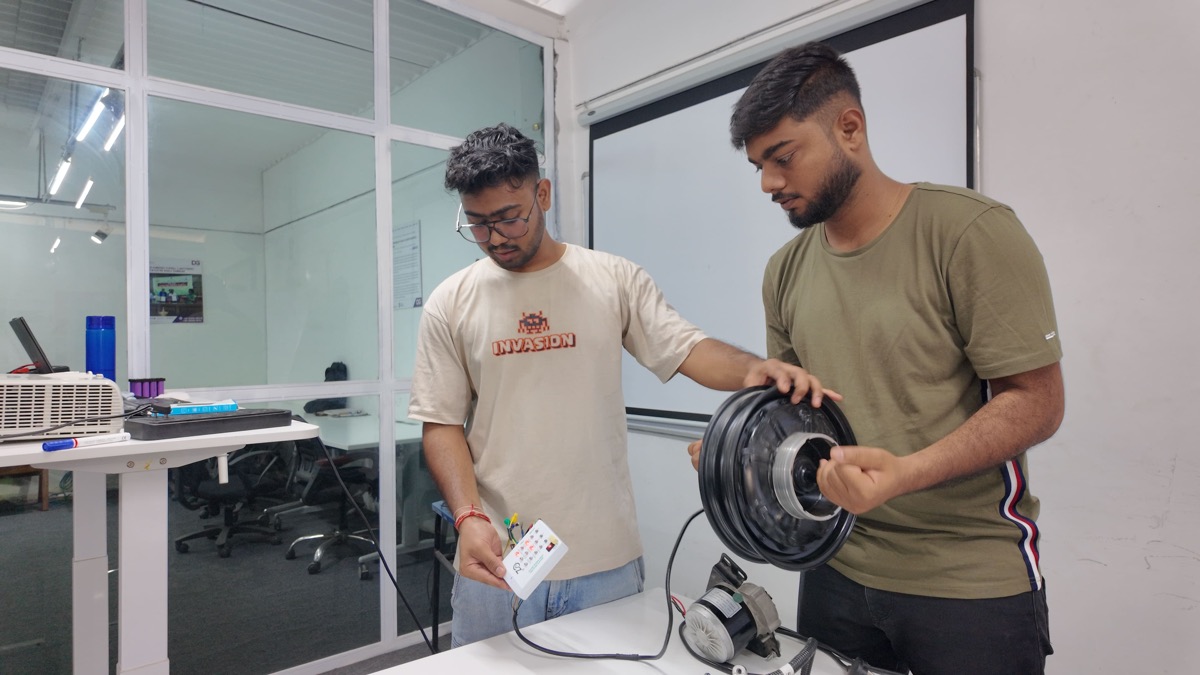
A hub motor only turns when the controller sees battery voltage, an enable signal, no brake signal, a throttle request and valid Hall sensor positions. If any one of these is missing the controller simply refuses to drive the motor, so a dead wheel is usually a missing input rather than a failed motor. Checking the inputs in order finds the break quickly.
What you need
Tools
- Digital multimeter with fine probes
- Insulated screwdrivers
- Torch or head lamp
- Centre stand or bike stand to lift the driven wheel
- Phone camera for photos of connectors
Materials
- Notebook for readings
- Electrical contact cleaner
- Spare blade fuses of the correct rating (if your vehicle uses them)
Before you start
- Always switch off and disconnect the battery before unplugging or inspecting connectors.
- Turning a hub motor by hand generates voltage at its phase wires; keep disconnected phase connectors apart and covered.
- Never bypass brake cut-off or side-stand switches to get the motor running.
- Do not open the battery pack, controller or sealed hub motor; opening sealed parts may void your warranty.
Step by step
- 1
Lift the wheel and note the symptoms
Put the scooter or e-bike on its centre stand so the driven wheel is off the ground. Switch on and note exactly what happens: does the display light up, is there an error code or icon, do the lights and horn work, does the motor hum, click or stay silent when you open the throttle? Write it all down. These clues tell you whether the problem is power, a signal or the motor itself.
Tip: Photograph the display with any error code before you switch off.
- 2
Check battery voltage at the outside
With the key off, measure DC voltage at the battery's output connector or charge port terminals as your manual allows, without opening the pack. Compare it with the nominal voltage on the label. A very low reading means the battery is flat or its BMS has switched the output off to protect the cells. Charge it with the original charger and test again before going further.
- 3
Inspect fuses, the main switch and the key
Find the fuse holder or circuit breaker shown in the owner's manual and check it visually and with the meter on continuity, battery disconnected. Confirm any battery lock key or main isolator is fully on. Replace a blown fuse only with the identical rating, and if the new one blows straight away, stop: something is shorted and needs a technician.
- 4
Rule out the brake cut-off and side-stand switches
Most controllers block the motor while a brake lever is pulled or the side stand is down. Check that both levers spring fully back and that the side stand is up. Many displays show a brake icon when the cut-off is active. A sticky lever or a switch stuck closed will stop the motor completely, so free the lever pivot before suspecting anything else. Never bypass these switches.
- 5
Check the throttle signal
With the key on and the wheel lifted, back-probe the throttle connector's signal wire against ground. Typical Hall throttles read under about 1 V at rest and rise smoothly to around 3.5–4 V at full twist, but follow your manual. No change means a faulty throttle or broken wire; no 5 V supply on the red wire points to the controller or its harness.
- 6
Inspect the motor connectors
Switch off and disconnect the battery. Follow the motor cable from the axle to the controller and unplug the phase and Hall connectors. Look for green corrosion, bent or pushed-back pins, melted plastic and water. Clean light corrosion with contact cleaner, let it dry, and reconnect firmly until the latch clicks. Check the cable where it leaves the axle, as that is where it often gets crushed.
- 7
Test the Hall sensors
Faulty Hall sensors often cause a motor that shudders, clicks or will not start but may spin if pushed. Follow the separate Hall sensor test guide to check each sensor's output while slowly turning the wheel. If one sensor never changes state, the motor needs repair at a workshop, because replacing Hall sensors means opening the hub, which may void warranty.
- 8
Decide what to fix and what to hand over
Summarise what you found: battery voltage, fuse condition, brake and throttle readings and connector condition. If everything external checks out, the fault is likely inside the controller or motor. Take your notes and photos to an authorised service centre. A precise description saves diagnosis time and stops parts being swapped at random.
Tip: Keep your readings with the vehicle's service records for next time.
How to tell it worked
Either the motor spins smoothly again after you fix a loose connector, sticky brake lever, fuse or throttle, or you have a written set of readings that pins the fault to the controller or motor for the service centre.
Stop and call a technician if
- A replacement fuse blows immediately or the breaker trips again.
- You smell burning, see melted insulation or find water inside the controller or connectors.
- The battery reads near zero volts or the pack is swollen, hot or damaged.
- The motor cable is cut or crushed at the axle.
Questions
The display works but the motor does nothing. Is the motor dead?
Usually not. A working display with a silent motor most often means a brake or side-stand cut-off is active, the throttle signal is missing, or a motor connector is loose.
Can I test the motor by connecting it straight to the battery?
No. A brushless hub motor needs a controller to switch its phases; connecting it directly to a battery causes a short circuit and can start a fire.
Will checking connectors void my warranty?
Unplugging external connectors as the manual allows is normally fine, but opening sealed parts such as the controller, motor or battery may void warranty. Check your warranty terms first.