
Why this happens
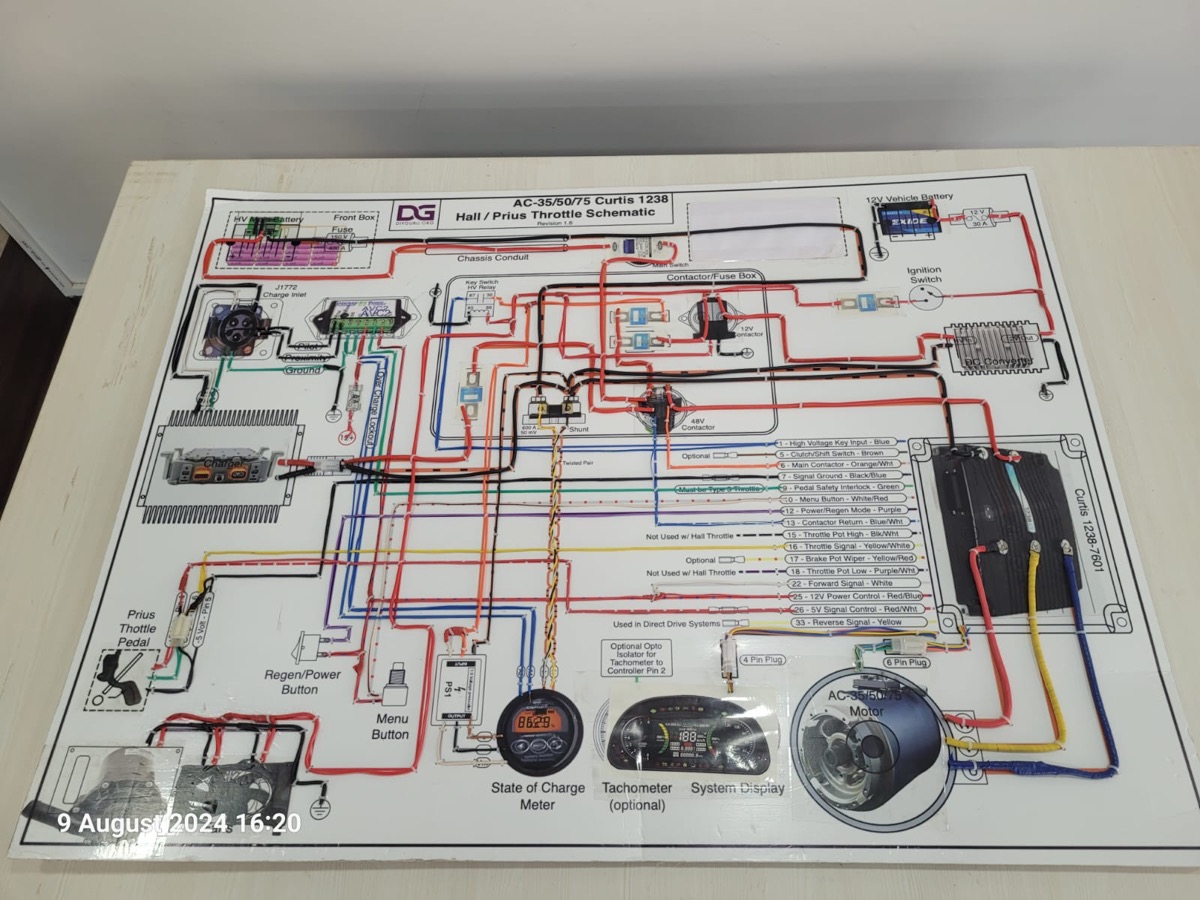
A short circuit is an unwanted low-resistance path, usually from a supply wire to ground, often caused by chafed insulation, water in a connector or a failed component. It blows fuses or trips protection repeatedly. Because a short shows as near-zero resistance between two points that should be separate, a meter on a de-energised circuit can find it safely by elimination.
What you need
Tools
- Digital multimeter with continuity and resistance modes
- Insulated screwdrivers
- Torch
- Wiring diagram or your own sketch
- Phone camera
Materials
- Labels and marker
- Notebook
- Insulating tape
- Replacement fuse of the correct rating
Before you start
- Only measure resistance and continuity on de-energised circuits.
- Never replace a fuse with a higher rating or a wire link to stop it blowing.
- Do not probe main battery cables, motor phase wires or high-voltage car wiring.
- Opening sealed harnesses or the controller may void warranty.
Step by step
- 1
Make everything dead
Switch off, remove the key and unplug the battery connector where the manual allows. Leave the blown fuse out. Measuring resistance on a live circuit gives wrong readings and can damage the meter. This guide covers low-voltage accessory and signal circuits such as lights, horn and indicators, not main battery cables or high-voltage car systems.
- 2
Identify the circuit that is shorted
Use the fuse that blew, or the function that stopped working, to identify the circuit. Find it on your wiring diagram or sketch. List every part it feeds, such as a headlight, horn and switch, and every connector along the way. This list is your search map.
- 3
Measure from the fuse to ground
Set the meter to resistance. Put one probe on the load side of the empty fuse holder, the side going to the accessories, and the other on a clean chassis ground or the circuit's negative wire. A reading near zero ohms confirms the short is somewhere downstream. A normal circuit usually shows a higher resistance through the loads.
- 4
Disconnect loads one at a time
Unplug each accessory in the circuit in turn while watching the meter. If the reading jumps up when you unplug one, that accessory is shorted internally. Replace it with a matching part. If unplugging all loads still leaves a near-zero reading, the short is in the wiring itself.
- 5
Divide the wiring into sections
Unplug the connectors along the harness to split it into sections. Measure each section's supply wire to ground separately. The section that still reads near zero contains the short. Keep halving the suspect length until you have narrowed it down to a short stretch of wire.
Tip: Photograph each connector before unplugging it so you can reconnect correctly.
- 6
Inspect the suspect stretch
Look closely where the wire passes edges, the steering head, under the seat hinge, past suspension parts and through clamps. Look for worn-through insulation, crushed wires, melted spots or water in connectors. Flex the wire gently while watching the meter; the reading may change as the bare spot touches metal.
- 7
Repair properly and protect the route
Repair a chafed wire with a crimped butt splice and adhesive heat-shrink, or replace the length. Then fix the cause: add a grommet, spiral wrap or reroute the wire so it cannot rub again. Dry any wet connectors and apply dielectric grease to the seals.
- 8
Recheck before fitting the fuse
Measure from the fuse holder to ground again; the near-zero reading should be gone. Fit a new fuse of exactly the original rating, reconnect the battery and test the circuit. If the fuse blows again, switch off and repeat the search, because there may be a second fault.
How to tell it worked
The resistance from the fuse holder to ground returns to its normal value, the new fuse of the original rating holds, and the accessory works without the fuse blowing again.
Stop and call a technician if
- The short is in the main battery cables, controller or motor wiring.
- You find melted insulation, burning smells or fire damage.
- The fuse keeps blowing after the repair and you cannot find a second fault.
Questions
Why does the resistance reading change slowly on some circuits?
Electronic loads often contain capacitors that charge from the meter's test current, so the reading climbs. A dead short stays near zero.
Can I find a short with the battery connected and a bulb in place of the fuse?
Some technicians do, but it involves live circuits. The de-energised resistance method in this guide is safer for DIY work.