
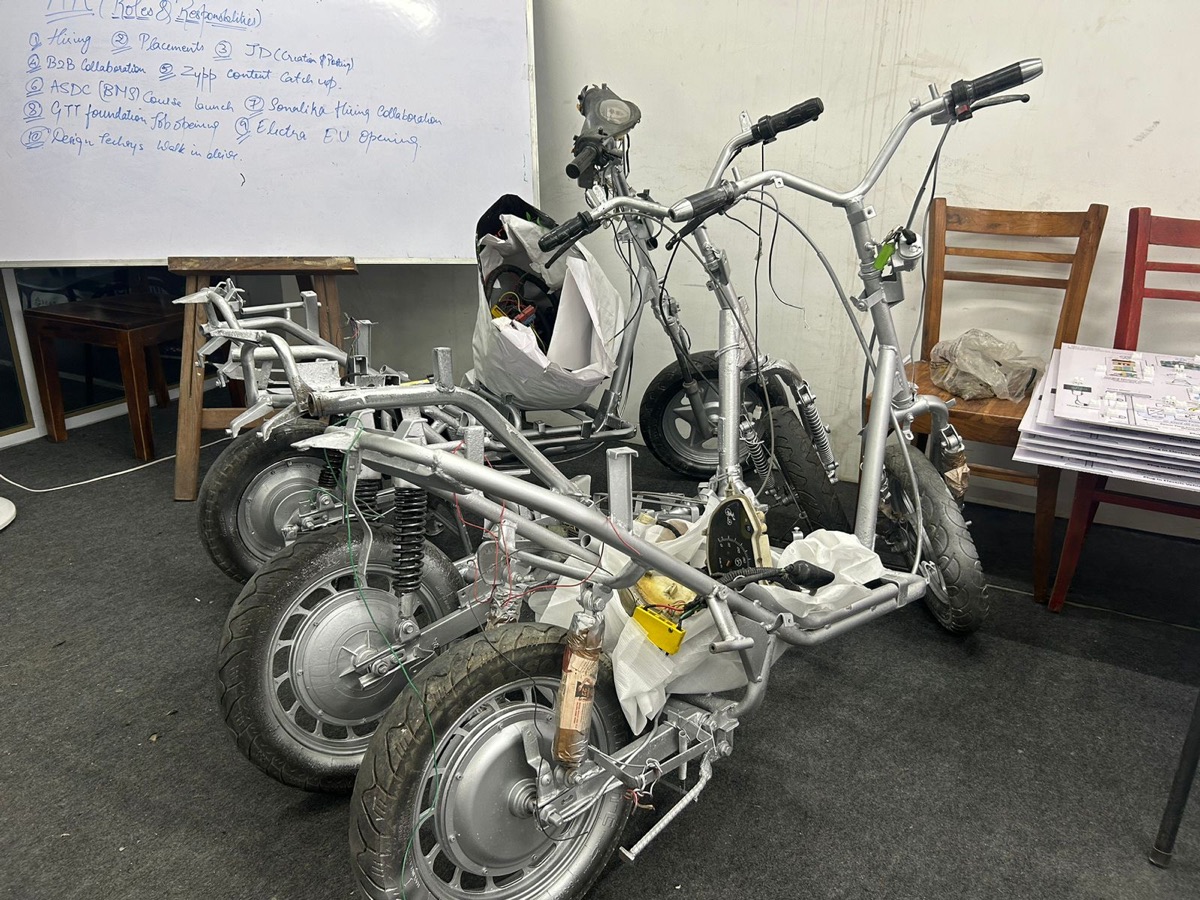
The problem
Electric two-wheeler makers weigh steel against aluminium frames: aluminium saves mass, which helps range, but costs more, needs larger sections for the same stiffness and loses strength in weld zones. A like-for-like comparison at equal stiffness, rather than equal dimensions, gives a fair answer.
Objectives
- Build a parametric frame where tube sizes are driven by a Design Table.
- Size steel and aluminium versions to the same bending and torsional stiffness.
- Compare stress, factor of safety and weld-zone margins in both materials.
- Estimate fatigue sensitivity, manufacturing cost and embodied carbon.
- Make a reasoned material recommendation for an example scooter.
What you need
Tools and toolboxes
- SOLIDWORKS Weldments and Design Tables — One frame with steel and aluminium configurations whose profiles and wall thicknesses are table-driven.
- SOLIDWORKS Simulation (Static) — Stiffness and strength load cases; Simulation Standard is enough.
- SOLIDWORKS Simulation (Fatigue) — Stress-life comparison under a repeated load; requires Simulation Professional or Premium. A hand S–N check is an alternative.
- SOLIDWORKS Costing — Weldment cost estimates with a consistent template; requires SOLIDWORKS Professional or Premium.
- SOLIDWORKS Sustainability / SustainabilityXpress — Embodied carbon and energy comparison; SustainabilityXpress handles parts only.
Software
- SOLIDWORKS 2023 or later (Professional or Premium for Costing)
- SOLIDWORKS Simulation (Professional for Fatigue)
- Excel
Extra parts and data
- Material datasheets — Weld-zone (heat-affected) strength for aluminium alloys and fatigue data should come from datasheets or design codes.
Key concepts
- Specific stiffness
- Young's modulus divided by density. Steel and aluminium are similar, so equal-stiffness aluminium tubes need larger diameters, not just thicker walls.
- Heat-affected zone
- The region near a weld whose strength is reduced by welding heat. For heat-treated aluminium alloys the drop is large, so weld locations matter.
- Endurance limit
- Many steels have a stress below which fatigue life is very long. Aluminium alloys do not show a clear limit, so they need more careful fatigue design.
- Equal-stiffness comparison
- Comparing designs that deflect the same under the same load. Comparing at equal dimensions would unfairly penalise aluminium's lower modulus.
Step-by-step guide
- 1
Fix the baseline frame and loads
Use an example scooter frame layout with a fixed wheelbase, steering head, swingarm pivot and battery bay. Define load cases: static rider plus payload of an example 150 kg, a 3 g bump and braking at 0.8 g. Choose an example steel such as AISI 4130 and an aluminium alloy such as 6061-T6, and record modulus, density, yield and weld-zone strength from datasheets.
Checkpoint: A load case table and a material table with all properties needed and their sources.
- 2
Make the frame table-driven
Model the frame in Weldments with custom round and rectangular profiles whose outer size and wall thickness are dimensions. Link these dimensions to a Design Table with configurations for steel and aluminium. Assign material per configuration in the table. Check that switching configuration rebuilds the frame and updates the cut list and mass. Add columns for weld length and mass so these values can feed the cost and carbon steps. Keep one row as the steel baseline and never edit it once stiffness targets are set.
Checkpoint: Switching between steel and aluminium configurations rebuilds the frame with updated mass and material.
- 3
Measure baseline stiffness
For the steel frame, run a bending study (load at the seat, supports at axles) and a torsion study (couple at the steering head, rear fixed) with beam elements. Calculate bending stiffness in N per mm and torsional stiffness in N·m per degree. These become the stiffness targets. Hand-check the bending stiffness with a simple beam model of the main rails.
Checkpoint: Baseline bending and torsional stiffness, with the bending value checked by hand within about 20 per cent.
- 4
Size aluminium for equal stiffness
Increase aluminium tube diameters and adjust walls in the Design Table to match the steel frame's stiffness within 5 per cent. Use the relation that bending stiffness scales with E·I, so aluminium needs roughly three times the I of steel. Run a small set of rows in the table and interpolate, rather than guessing. Check packaging with Interference Detection, since larger tubes may clash with the battery.
Checkpoint: An aluminium configuration within 5 per cent of steel stiffness in both bending and torsion, and passing Interference Detection.
- 5
Compare strength
Run the bump and braking studies on both configurations. Plot Factor of Safety based on parent yield. Then identify welded joints and calculate weld-zone factor of safety using the reduced heat-affected strength for aluminium. Use solid or shell sub-models of the most loaded joint if beam stress at the node is not reliable enough. Remember that some aluminium alloys can be re-heat-treated after welding to recover strength, which changes cost; note whether you assume this.
Checkpoint: A table of parent and weld-zone factor of safety for both materials and every load case.
- 6
Compare fatigue sensitivity
Define an example repeated load, such as the bump load applied as a fully reversed or zero-to-peak cycle. In a Fatigue study, use S–N curves from datasheets, not defaults, for each material and compute life at the critical joint. If you do not have Simulation Professional, do a hand stress-life check with the peak stress and the material S–N data. Note that weld detail categories dominate real fatigue life.
Checkpoint: Estimated life or damage for both materials at the same load, with the source of S–N data stated.
- 7
Estimate cost
Run SOLIDWORKS Costing on both weldment configurations using the same template, adjusted with example material prices per kg and labour rates you state clearly. Include cutting, welding length and heat treatment for aluminium if needed. If Costing is not available, build an Excel cost model from cut-list lengths, mass and weld length. Run a quick sensitivity by changing the material price per kg and the labour rate by 20 per cent to see whether the cost ranking changes.
Checkpoint: A cost comparison with every rate and assumption listed.
- 8
Estimate embodied carbon
Use SOLIDWORKS Sustainability for the assembly, or SustainabilityXpress per part, with the region and process set consistently. Record carbon footprint and energy for both frames. Discuss the effect of recycled content, which can change aluminium's figure a lot. Make clear that these are tool estimates for comparison, not certified life-cycle results. Run both a primary and a high recycled-content aluminium case and show how the comparison with steel moves between them.
Checkpoint: Carbon and energy estimates for both frames with settings recorded.
- 9
Estimate the range effect
Take the mass difference and use a simple road-load calculation in Excel for an example scooter on an urban cycle to estimate the change in energy per kilometre. Compare it with the cost difference to give a cost per kilogram saved. Keep the calculation transparent so a reader can change the assumptions. Express the result both as Wh per km and as a percentage of total consumption, and note that mass has the largest effect in stop-start urban driving.
Checkpoint: A short calculation of energy saving per kilometre from the mass saving, with stated assumptions.
- 10
Recommend and report
Build a decision table with mass, stiffness, parent and weld factor of safety, fatigue result, cost, carbon and range effect. Weight criteria for the example use case and recommend a material. Produce drawings of both frames with cut lists. State that fatigue of welded joints and real costs must be confirmed by testing and supplier quotes. Show how the recommendation changes if the weights favour cost over range, so the reader can see how robust the choice is.
Checkpoint: A decision table, a recommendation and drawing packs for both frames.
Testing & validation
- Both frames matched in stiffness within 5 per cent.
- Baseline stiffness checked by hand.
- Weld-zone strength included for aluminium.
- S–N data source stated for fatigue estimates.
- All cost and carbon assumptions listed.
Expected results
A fair, equal-stiffness comparison of steel and aluminium versions of the same EV two-wheeler frame covering mass, strength, weld-zone margins, fatigue, cost, embodied carbon and range effect, with a reasoned recommendation.
Research angle for your M.Tech thesis
Ask whether equal-stiffness aluminium frames for Indian two-wheeler duty cycles deliver a net benefit once weld-zone strength, fatigue and embodied carbon are included. Metrics: mass saving, cost per kilogram saved, carbon per kilogram saved and energy per kilometre. A transparent, reproducible comparison with sensitivity to recycled content and material prices is the contribution.
Take it further
- Add a magnesium or composite option to the comparison.
- Build physical sample joints and fatigue-test them.
- Extend the decision table into a multi-criteria method such as weighted sum with sensitivity to weights.
Viva and review questions
Why compare at equal stiffness rather than equal dimensions?
Aluminium has about a third of steel's modulus, so identical tubes would be much more flexible. Equal stiffness compares designs that behave the same for the rider.
Why is the weld zone important for aluminium?
Heat from welding lowers the strength of heat-treated aluminium near the weld considerably, so the weld often governs the design rather than the parent tube.
How reliable are the cost and carbon figures?
They are comparative estimates that depend on templates and settings. I used the same assumptions for both frames and listed them, but real decisions need supplier quotes and certified data.
Learn it at DIYguru
These DIYguru courses and programmes teach what this project needs.
- CourseCertification Course in 2W EV Design & Modeling with SOLIDWORKS
- CourseCertification Course in 2W & 4W EV Design & Modeling with SOLIDWORKS
- ProgrammeAdvanced Nanodegree Certification Program in EV Engineering, Automotive Design, Development, & Dynamic Analysis
- ProgrammePCP in EV Automotive Design & Simulation