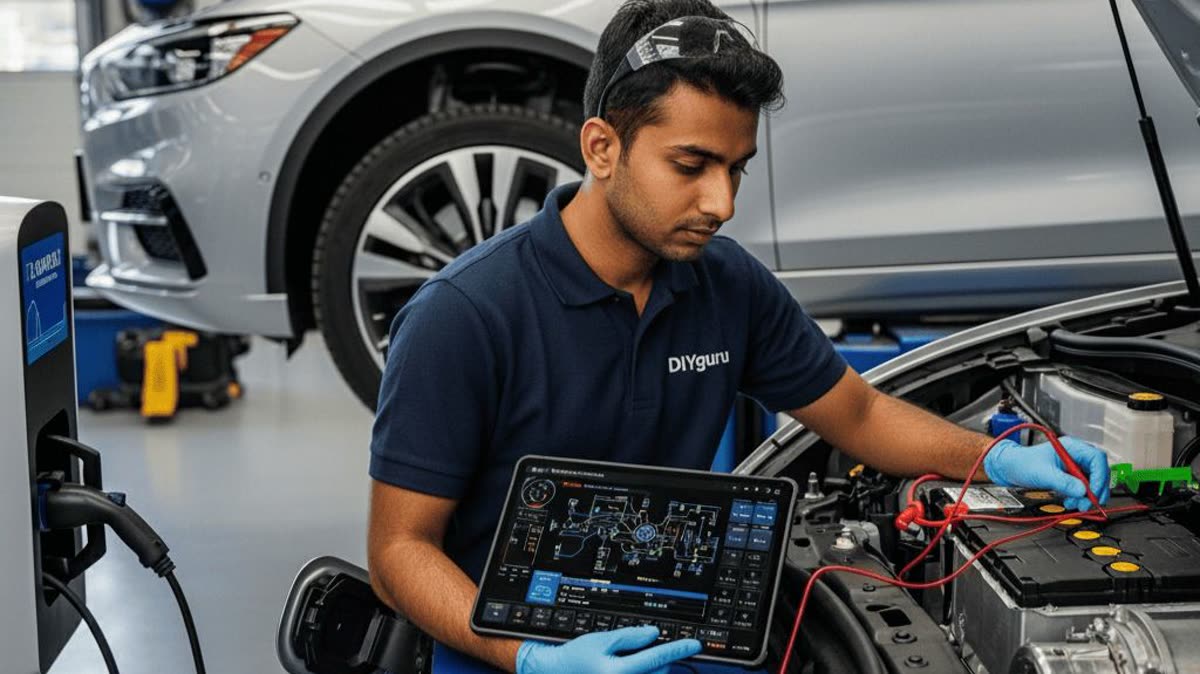
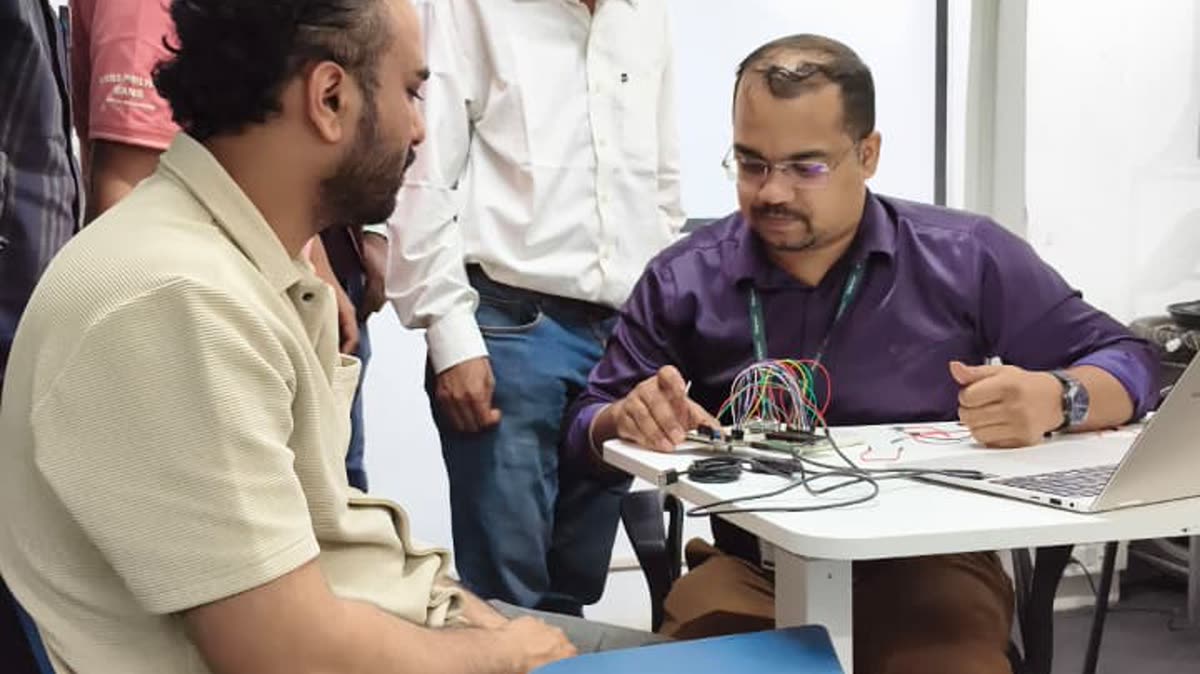
Online EV courses are flexible and affordable; hands-on training is where you learn to use tools on real vehicles. Neither is better on its own: the right mix depends on the job you want. Here is what each does well and how to combine them.
Updated 15 November 2026 · eMobility Academy
What online EV training does well
Most of what an EV engineer or technician needs to understand can be taught well online, especially with live classes rather than recorded videos alone.
Theory: battery chemistry, BMS, motors, controllers, charging standards and EV architecture.
Design and simulation: MATLAB and Simulink models, CAD in SOLIDWORKS, circuit design.
Embedded programming: firmware, CAN communication and sensor code, especially with a hardware kit at home.
Flexibility: study from any city or country, revise from recordings, and keep working or studying.
What needs hands-on training
Some skills only come from working on real equipment under supervision. If you want to service or repair EVs, these are not optional.
Using testing equipment: multimeters, clamp meters, insulation testers, e-bike testers and OBD scanners.
High-voltage safety in practice: PPE, isolation and safe measurement on real systems.
Battery, motor and controller diagnosis on real two- and four-wheelers.
Fault finding and servicing in a workshop, with a trainer checking your work.
Side by side
Online (live + recorded)
Hands-on workshop
Best for
Theory, design, simulation, programming
Tools, safety practice, diagnosis, servicing
Where
Anywhere
A training centre with vehicles and equipment
Pace
Flexible, with recordings
Fixed days in a batch
Cost
Lower
Higher (lab, equipment, trainers)
Needed for technicians?
Yes, for the theory
Yes, essential
Needed for design engineers?
Yes, most of the work
Helpful, not always essential
The blended route
Our programmes combine both. Theory is taught in live online classes with recordings, so you can join from anywhere. The CEVT technician programme adds a 3-week practical workshop, and the PG programme adds hands-on workshop modules on two-wheelers, four-wheelers and embedded systems, at our Delhi and Pune centres.
For design and embedded learners, the EV Embedded Development Kit brings real hardware home: two controllers, a battery management unit, CAN, sensors and displays on one board, so you can write firmware and test it without travelling.
How to choose
Want to repair or service EVs? Choose a programme with a real hands-on workshop, such as CEVT.
Want to design EVs or work in simulation? Online with projects is enough to start; add a workshop later if you want.
Want embedded or firmware work? Online classes plus a hardware kit give you most of the practice you need.
Live outside India? Learn online; hands-on workshops are at our centres in India.
CEVT is a three-month, live and hands-on Certified Electric Vehicle Technician programme that prepares ITI, Diploma and Polytechnic learners for careers in 2W and 4W EV…
A 12-month, hybrid Post Graduate Certificate Programme in EV & Embedded Technology, created by IIT Jammu in collaboration with I3C–IIT Jammu and DIYguru, that takes…
A six-month, live and hands-on Advanced Nanodegree in Embedded Systems for EV engineering, created by IIT Jammu in collaboration with I3C–IIT Jammu and DIYguru. You…
IIT JammuASDC
6 MonthsOnline + Campus
View Details
Fees on request
Common questions
Can I learn EV repair online?
You can learn the theory online, but repair skills need hands-on practice with tools and real vehicles under supervision. That is why the CEVT programme includes a 3-week practical workshop.
Is an online EV course recognised?
What matters is the programme behind it. Our programmes end with a certificate employers can verify online, and their recognition (such as ASDC or AICTE NEAT) is listed on each programme page.
Where are the hands-on workshops held?
At DIYguru's training centres in Delhi (Sultanpur) and Pune.
Do I need to buy a kit for an online EV course?
No. The EV Embedded Development Kit is optional; it helps if you want to practise embedded programming on real hardware at home.

 Technician