
For universities & colleges
Set up an EV lab at your college
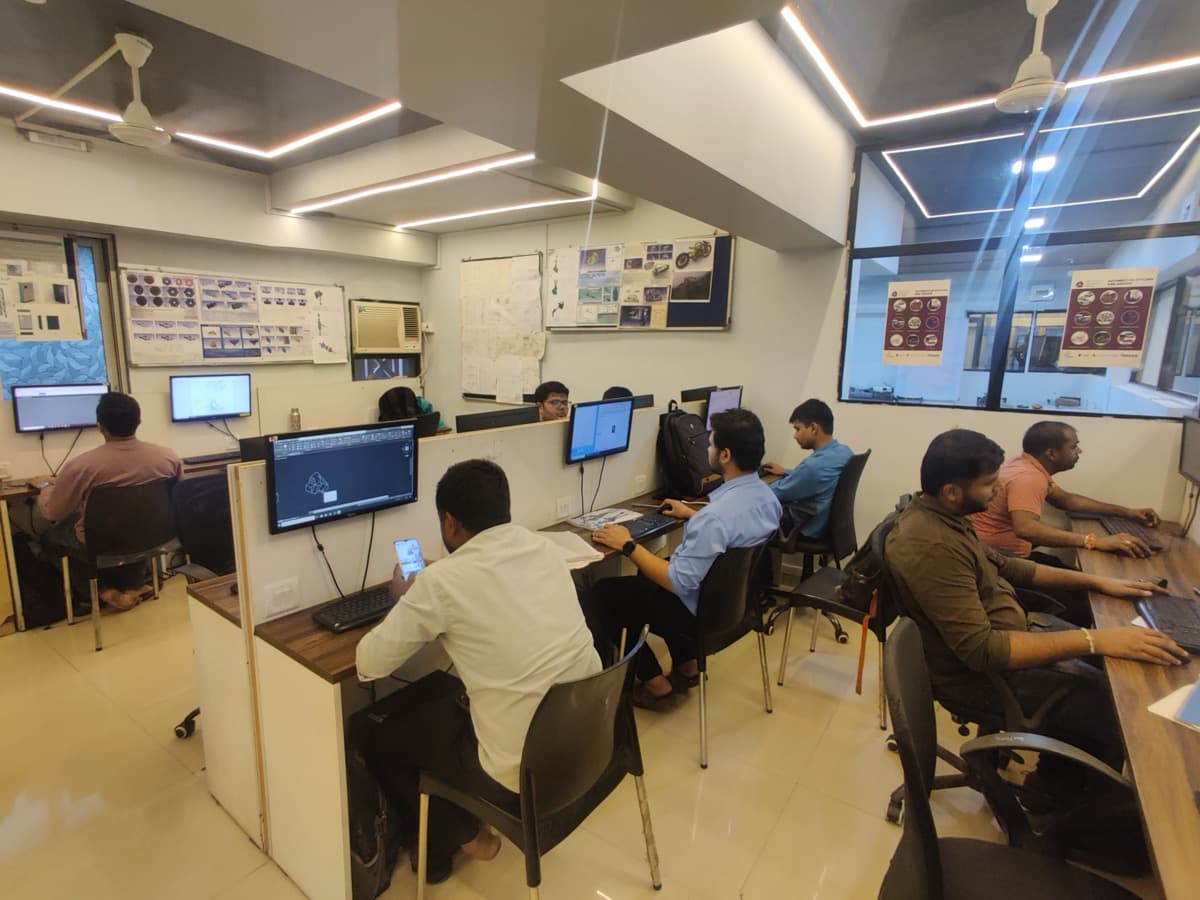
A turnkey E-Mobility lab or Centre of Excellence: industry-grade workbenches developed with IIT Delhi, lab manuals mapped to AICTE outcomes, and training for your faculty. We handle the design, installation and launch; you provide the room.
- Workbenches built by IIT Delhi start-ups
- 20+ hands-on experiments with manuals
- 5-day faculty training included
Get a lab proposal
Tell us about your institution and department. We reply with a layout, hardware specification, curriculum mapping and pricing.
IIT Delhi CART
Technical governing body for the lab equipment (advisor: Prof. B. K. Panigrahi)
EVI Technologies & Tadpole Projects
IIT Delhi start-ups that manufacture the workbenches
L&T EduTech
National e-mobility upskilling initiative, with DIYguru as training partner
What's in the lab
EV lab equipment
Pick the workbenches that fit your departments; each comes with its experiments, manuals and faculty training.
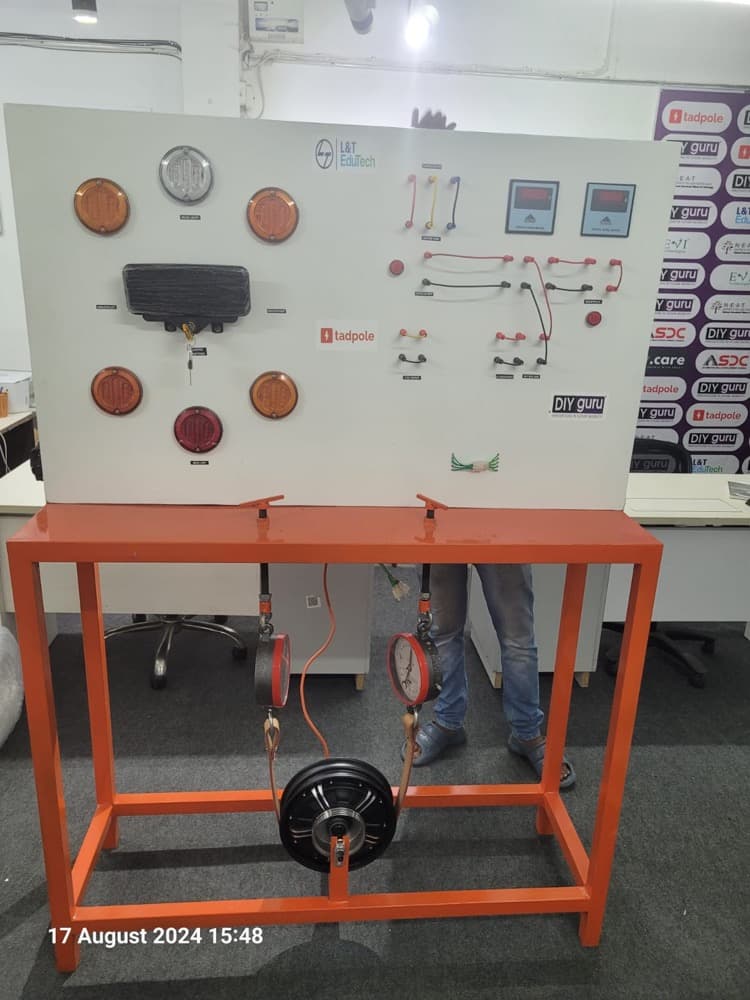
2-wheeler EV simulator & test bench
Hub motor, 48–72 V controller, DC-DC converter, smart BMS and wiring harness on one bench, with load, efficiency, speed-torque, regenerative and BMS tests.
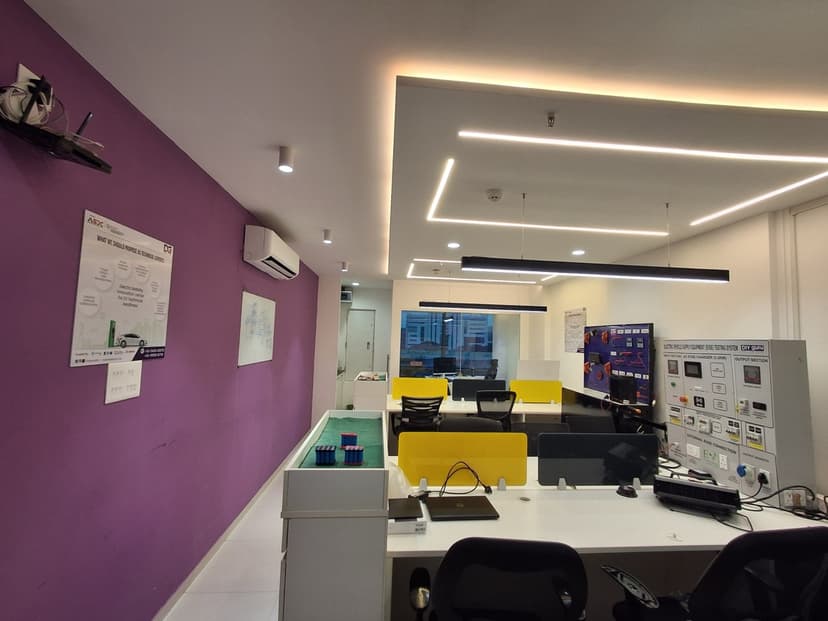
Charging station simulator & test bench
3.3 kW EVSE testing with multiple input and output loads, RFID and Wi-Fi/4G communication, charging modes and safety checks to AIS and IS norms.
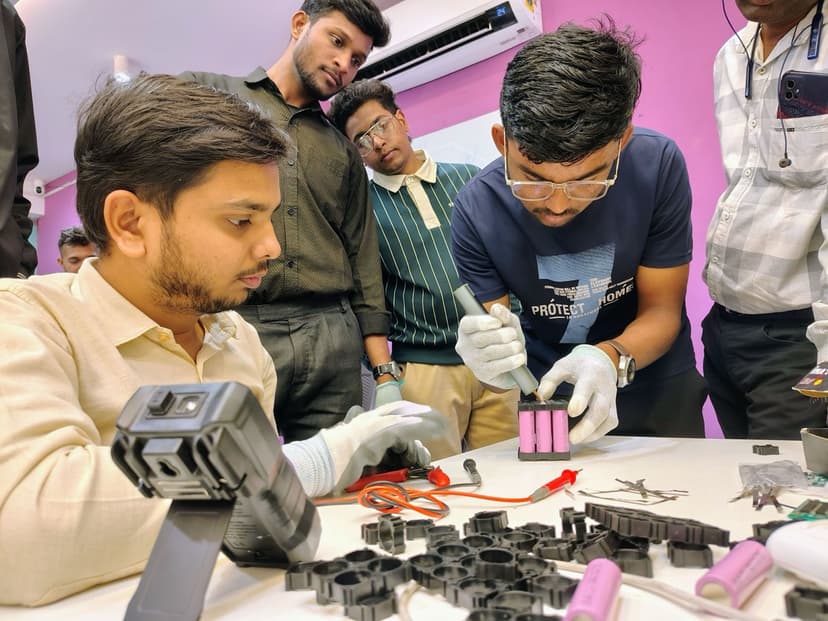
Battery, BMS & cell lab
Cell charge-discharge machine, internal-resistance tester, portable spot welder and a DIY battery-pack build (24 V, 7S4P) with BMS integration.
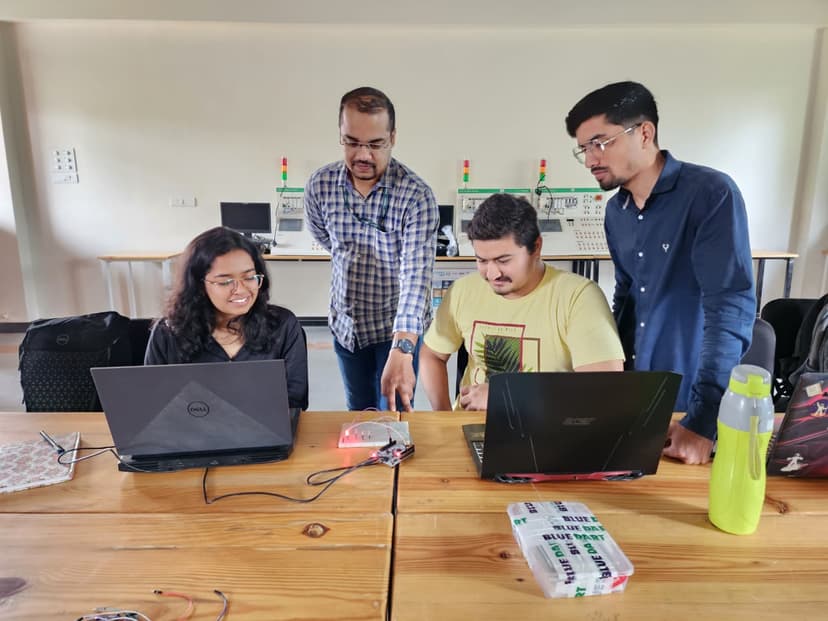
EV embedded systems kits
Two-controller STM32 boards with BMS, CAN, sensors and displays for firmware, battery-management and HIL/SIL experiments.
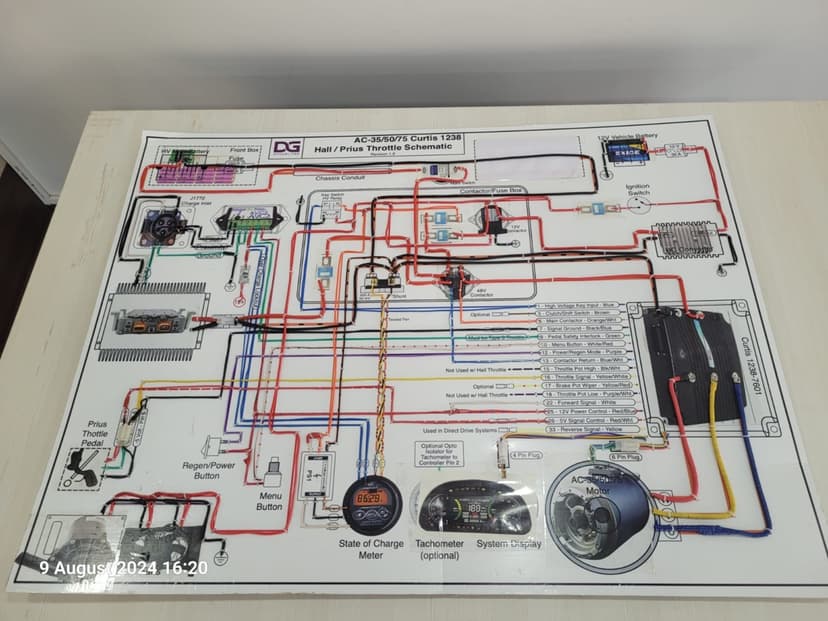
Wiring harness & practice boards
Harness boards with every component labelled, and practice boards that trace energy from source to motor.
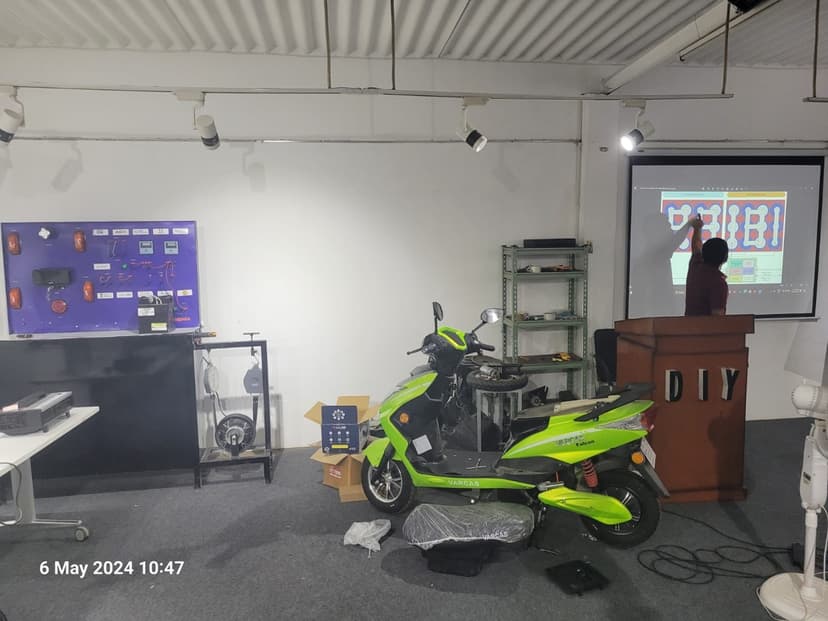
EV components & retrofit
Component analysis table (motors, controller, BMS, charger, cluster, cells), a bare EV chassis, and an ICE-to-EV retrofit two-wheeler with a test bed.
How it works
From proposal to a working lab in 8–12 weeks
- 01
Site assessment
Our team visits your campus, or audits it online, to check space, power and existing equipment.
- 02
Lab design
A layout with workbench placement, electrical requirements, safety measures and student capacity.
- 03
Manufacture & install
Workbenches are built, shipped, installed and calibrated on site, then commissioned and tested.
- 04
Faculty training & launch
A 5-day train-the-trainer programme, curriculum handover and lab inauguration.
Packages
Start small or build a full Centre of Excellence
Pricing is shared in your proposal and depends on the workbenches and student capacity.
Starter
EV Learning Corner
- 1 EV training workbench of your choice
- Embedded hardware kit
- 10 lab experiments with manuals
- 3-day faculty orientation
Most chosen
E-Mobility Lab
- All 3 EV training workbenches
- 20+ experiments with full lab manuals
- 5-day certified faculty training
- Complete curriculum, PPTs and assessments
- 12 months of support and content updates
Full CoE
Centre of Excellence
- Everything in the E-Mobility Lab
- 4-wheeler EV diagnostic rig
- MATLAB/Simulink simulation workstations
- Charging station test infrastructure
- Research collaboration and industry introductions
With L&T EduTech
A national e-mobility programme for colleges
With L&T EduTech, DIYguru built an e-mobility vertical for higher-education institutions: E-Mobility Centres of Excellence with hardware labs in six categories, 12 training packages across electrical, electronics, mechanical and automotive domains, 40 modules with more than 550 hours of content and 180+ hours of hardware-enabled training, and a series of technical reference books.
Institutions we work with
- Manipal Academy of Higher Education
- Sikkim Manipal University
- Sri Sri University
- KIIT, Bhubaneswar
- KIET, Ghaziabad
- GCE Karad
- Acharya Institute of Technology
- DAV University, Jalandhar
- Manav Rachna (MRIIRS), Faridabad
- Tatyasaheb Kore Institute of Engineering & Technology
- Ajeenkya DY Patil University, Pune
EV workshops for colleges · Faculty development programmes · EV embedded kit
FAQs
EV lab set-up: common questions
How long does it take to set up an EV lab?
Typically 8–12 weeks from the signed proposal to the lab inauguration: about 4–6 weeks to manufacture the workbenches, 1–2 weeks to ship and install, and a week of faculty training.
Is the curriculum aligned with AICTE and NBA requirements?
Yes. Experiments come with lab manuals, student worksheets and assessment rubrics mapped to AICTE programme outcomes (POs and PSOs), which helps with NBA documentation.
Do you train our faculty?
Yes. Every package includes faculty training on all workbenches, teaching guidance and lab operation manuals, so your faculty can run the experiments independently.
Can we start small and expand later?
Yes. Many institutions start with one workbench and add the others over time; each addition comes with its curriculum and training.
Can the lab be funded through CSR or government grants?
Institutions often use industry CSR, the AICTE MODROB scheme, DST-FIST grants or state skill-development funds. We provide documentation support for grant applications.
What does an EV lab cost?
It depends on the package, the number of workbenches and your student capacity. Send an enquiry and we will share a proposal with the layout, hardware specifications, curriculum mapping and pricing.