
AUTOSAR training is where you stop reading about layers and start doing the work an AUTOSAR engineer does every day: editing ARXML, configuring Basic Software, generating the RTE, integrating code on a microcontroller and tracing CAN messages when something breaks. This guide explains what hands-on AUTOSAR training should include, the tools you will meet, the training formats available in India (online, classroom and corporate), the skills each step builds, and how to reach a job with placement support.
Quick answer: Good AUTOSAR training follows the real project workflow: system design → ECU extract → BSW configuration → RTE and code generation → integration and testing on hardware. Expect 3–6 months of live, mentored practice to reach entry-level job readiness. DIYguru runs this as the 6-month Nanodegree in ADAS & AUTOSAR (live online, optional ARM Cortex kit), and as the AUTOSAR specialisation inside the 12-month PG in EV & Embedded Systems, which includes placement support.
AUTOSAR training vs an AUTOSAR course
The two terms are used loosely, but the difference matters when you are paying for one:
| AUTOSAR course | AUTOSAR training | |
|---|---|---|
| Goal | Understand the standard | Do the work on tools and hardware |
| Typical length | 20–40 hours | 3–6 months, part-time |
| Format | Recorded lessons, quizzes | Live sessions, labs, mentor reviews |
| Output | Certificate and concept project | Configured, integrated, tested project you can demo |
| DIYguru option | AUTOSAR for EVs (₹10,000 + GST) | ADAS & AUTOSAR Nanodegree or the PG |
If you are new to the topic, read our AUTOSAR course guide first. It covers the architecture and syllabus in detail.
The AUTOSAR workflow that training should walk you through
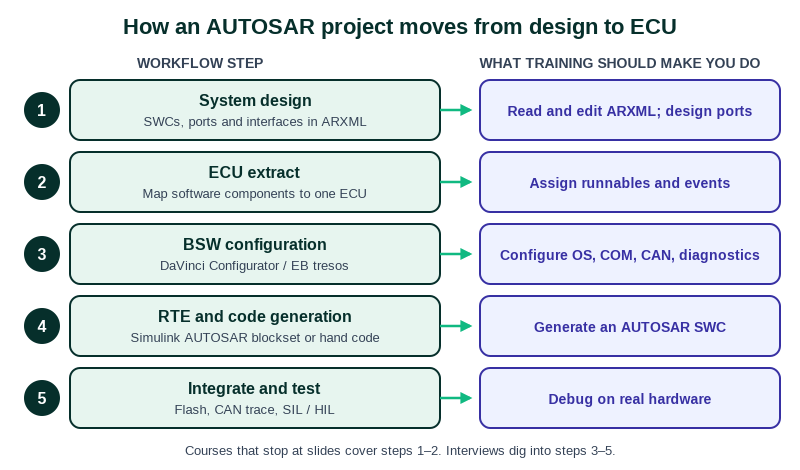
1. System design
You define software components, their ports (sender-receiver or client-server) and data types, all stored as ARXML. Training should have you read and change real ARXML, not just look at diagrams of it.
2. ECU extract
Components are mapped to a specific ECU. You decide runnables and the events that trigger them (timing, mode switch, operation invoked), which sets the task design of the ECU.
3. BSW configuration
This is the largest share of AUTOSAR work in India. You configure the OS (tasks, alarms, priorities), the communication stack (COM, PduR, CanIf, CAN driver), memory (NvM) and diagnostics (DCM, DEM) in tools such as Vector DaVinci Configurator or EB tresos.
4. RTE and code generation
The RTE is generated from the configuration. Application components come from hand-written C or from Simulink models exported with the AUTOSAR Blockset. Training should include at least one Simulink-to-AUTOSAR component.
5. Integration and testing
The build is flashed to the target, CAN traffic is checked and the behaviour is tested in software-in-the-loop (SIL) or hardware-in-the-loop (HIL) set-ups. This is where most freshers have no experience, and where interviewers dig deepest.
Tools used in AUTOSAR training
| Tool | Used for | In DIYguru training |
|---|---|---|
| Vector DaVinci Developer / Configurator | SWC design, BSW and RTE configuration | Demonstrated and practised in the nanodegree |
| EB tresos Studio | BSW and MCAL configuration | Demonstrated in the nanodegree |
| AUTOSAR Builder | Architecture design, ARXML, RTE generation | Used for architecture and RTE topics |
| MATLAB / Simulink with AUTOSAR Blockset | Model-based design of SWCs, code generation | Hands-on (AUTOSAR TPS sensor composition and more) |
| STM32CubeIDE | Firmware, MCAL-level drivers on ARM Cortex-M | Hands-on with the optional embedded kit |
| CAN analyser (CANoe / CANalyzer or open tools) | Bus traces, signal checks | CAN basics and traces on the kit |
Training formats in India
Live online AUTOSAR training
Best for working engineers and students outside the big hubs. You attend live sessions, practise on your own laptop and kit, and get mentor reviews. DIYguru's nanodegree runs this way, with recordings of every class if you miss one.
Classroom and lab AUTOSAR training
Useful when you want to work on shared hardware such as HIL rigs and lab benches. DIYguru runs hands-on sessions at its New Delhi and Pune training centres. City pages are at EV training locations.
Corporate AUTOSAR training
For OEMs, Tier-1 suppliers and engineering service companies that need to upskill teams moving from non-AUTOSAR firmware or from mechanical domains. DIYguru designs these as cohort programmes with a project on the company's own use case. See DIYguru for business.
AUTOSAR training in Bangalore, Pune, Chennai, Hyderabad and NCR
These cities have most of India's AUTOSAR openings, and they are also where many people search for "AUTOSAR training near me". You do not need to relocate for training. The live online classes are the same wherever you join from, and the kit is delivered to your address. If you prefer working on lab hardware, combine online classes with sessions at the New Delhi or Pune centres.
AUTOSAR training with placement
At DIYguru, placement support comes with the PG programme in EV & Embedded Systems only. It runs for 12 months:
- Months 1–8: core training in EV systems, simulation, embedded programming (STM32, ARM Cortex, AUTOSAR) and hardware labs.
- Months 9–10: specialisation (choose ADAS, AUTOSAR, hydrogen or advanced powertrain) and a capstone project.
- Months 11–12: placement preparation (mock interviews, resume and portfolio review), final technical test and viva.
Learners who clear the Placement Eligibility Test are supported by the Career Support Cell, which handles employer mapping, referrals and placement drives through emobility.careers. The nanodegree includes mentoring and career guidance but is not a placement programme.
Skills you should be able to show after training
- Explain the path of one signal from a sensor through MCAL, ECU abstraction, COM and RTE to a software component.
- Create a software component with sender-receiver and client-server ports, and map its runnables to OS tasks.
- Configure a CAN communication path (CAN driver → CanIf → PduR → COM) and check it on a trace.
- Generate an AUTOSAR component from a Simulink model and integrate it.
- Read a DEM / DCM configuration and explain how a diagnostic trouble code (DTC) is stored.
- Debug a build on an ARM Cortex-M target over SWD.
Interview topics AUTOSAR training should prepare you for
- Difference between Classic and Adaptive AUTOSAR, and where each is used.
- Role of the RTE; what happens when you change a port interface.
- Explicit vs implicit sender-receiver communication.
- OS task design: basic vs extended tasks, alarms, schedule tables.
- Communication stack layers and the role of PduR.
- NvM block types and write strategies.
- Complex device drivers: when and why.
- Where functional safety (ISO 26262) fits in an AUTOSAR ECU.
Frequently asked questions
How much does AUTOSAR training cost in India?
Self-paced AUTOSAR certification costs about ₹10,000 + GST at DIYguru. Live, hands-on training in the six-month ADAS & AUTOSAR nanodegree has fee slabs from ₹49,999 + GST, with EMI and DET scholarships of up to ₹50,000. Corporate training is quoted per cohort.
What is the duration of AUTOSAR training?
Plan on 3–6 months part-time to become job-ready, and 12 months if you want the full EV and embedded foundation plus placement preparation.
Is AUTOSAR training available online?
Yes. DIYguru's AUTOSAR training is live online with recordings, mentor sessions and an optional kit delivered to your home. Hands-on lab sessions are available in New Delhi and Pune.
What are the prerequisites for AUTOSAR training?
C programming and basic microcontroller knowledge. If you have neither, start with an embedded systems training path or take the nanodegree with the embedded kit, which covers STM32 basics.
Is AUTOSAR BSW training different from application training?
Yes. BSW training goes deep into OS, communication, memory and diagnostics configuration. Application (SWC) training focuses on component design, model-based development and RTE interfaces. Good training covers both, then lets you specialise.
Can mechanical engineers do AUTOSAR training?
Yes, if you are willing to learn C first. Many mechanical and EV engineers move into model-based design roles, where Simulink skills plus AUTOSAR knowledge are in demand.
Does DIYguru offer AUTOSAR corporate training?
Yes, for OEMs, Tier-1 suppliers and service companies. Write to the team through DIYguru for business.
Related guides: Best AUTOSAR courses in India compared · AUTOSAR course · ADAS training · ADAS course · Embedded training · Embedded and HIL / SIL engineer
Sources: AUTOSAR — Release Event R25-11; AUTOSAR CP Methodology R25-11; MathWorks — AUTOSAR Blockset; DIYguru programme pages (structure and fees as listed, November 2026). Updated 28 November 2026.