emobility.academy
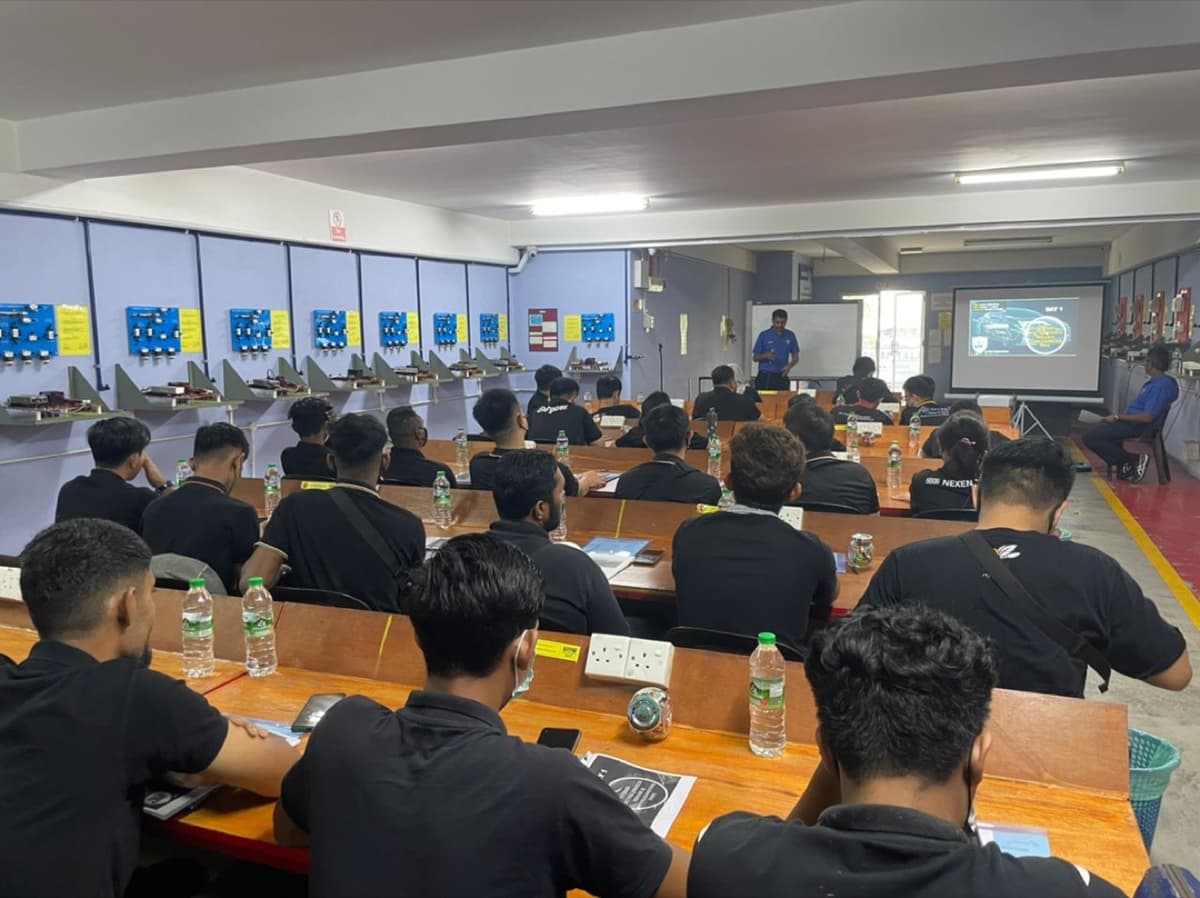
A trainer-led EV class with wiring trainer boards along the wall

For engineering colleges & universities

Semester-Integrated EV Training Program for Engineering Colleges

Run a full semester of electric vehicle training inside your academic calendar. DIYguru plans the course with your department: online lessons and live sessions through the week, hands-on lab blocks on battery packs, motors, chargers and embedded kits, and a capstone project that final-year students submit for evaluation. Every student who completes it gets a verifiable certificate.

  • Planned around your semester timetable
  • Online lessons + hands-on lab blocks
  • Capstone project with mentor reviews
  • Verifiable certificate for every student

Plan a semester-integrated EV programme

Share your college, departments, number of students and semester dates. We reply within one working day with a plan and quotation.

Duration

One semester

Mode

Online + on-campus lab blocks

For

Final-year & pre-final-year B.Tech / B.E.

Output

Capstone project + certificate

Why it matters

Why run EV training across a whole semester

A two-day workshop introduces electric vehicles; it does not leave students able to size a battery pack, tune a motor controller or debug a CAN bus. Final-year students need time to learn the system, practise on real hardware and finish a project they can explain in an interview.

A semester-integrated programme gives them that time without adding to your department's load. DIYguru supplies the course on its learning portal, the trainers, the lab kits and the project mentoring; your faculty keep academic ownership and grading. It is the same practical approach we use to train engineering teams at companies such as Hyundai Motor India, HL Mando, Honda Car India and TCS.

Fits your calendar

Weekly hours, lab blocks and project reviews are scheduled around your timetable, internal exams and holidays.

Hands-on, not slides

Battery packs, BMS boards, BLDC motor rigs, EVSE and embedded kits come to your campus for the lab blocks.

A gradable capstone

Students submit a report, results and a demo that your faculty can evaluate as project work.

Faculty in the loop

Your faculty co-teach, and can take our faculty development programme to run later batches themselves.

Formats

Programme formats

We plan every programme with your department: branches, number of students, hours per week and how it is assessed.

One semester Online + on-campus lab blocks

Final-year EV programme with capstone

EV systems, battery and BMS, motors and controllers, charging and embedded control in the first half; a mentored capstone project through the second half.

Quoted for your batch

Plan this programme
One semester Online + lab days on campus

Pre-final-year EV foundation

A lighter weekly schedule in the third year that builds EV fundamentals and lab skills, so students start their final-year project with hands-on background.

Quoted for your batch

Plan a foundation batch
One semester Online + on-campus lab blocks

Specialisation semester

A full semester on one stream: battery pack & BMS design, motor drives & control, EV design & simulation (MATLAB / Simulink) or embedded systems for EVs.

Quoted for your batch

Choose a stream
One semester Online + Delhi / Pune lab visit

Online semester with a lab visit

Lessons, live sessions and simulation projects online through the semester, with a block of hands-on days at our Delhi or Pune lab.

Quoted for your batch

Plan an online semester

Curriculum

What the semester covers

01

EV fundamentals

  • EV architecture: 2W, 3W and 4W
  • Powertrain: motor, controller, transmission
  • Vehicle dynamics and range calculations
  • High-voltage safety and PPE

02

Battery pack & BMS

  • Li-ion cells, chemistries and cell grading
  • Series / parallel pack design and calculations
  • BMS functions: balancing, protection, SOC
  • Pack assembly, spot welding and testing

03

Motors & controllers

  • BLDC and PMSM motors
  • Motor controller wiring and tuning
  • Motor test rig: speed, torque, efficiency
  • Fault finding on a running drivetrain

04

Charging & diagnostics

  • AC and DC charging, connectors and EVSE
  • On-board charger and charging safety
  • OBD and CAN diagnostics
  • Service, troubleshooting and repair workflow

05

Embedded systems for EVs

  • Microcontrollers (Arduino / STM32)
  • Sensors, PWM and motor control code
  • CAN communication basics
  • Data logging from a real EV system

06

Capstone project

  • Problem statement agreed with your faculty
  • Design calculations, block diagram and bill of materials
  • Build or simulate, test and record results
  • Final report, presentation and demo for evaluation

Outcomes

What students and the college get

  • Students who have worked on real EV batteries, motors, chargers and embedded systems
  • A completed capstone project per student or team, ready for evaluation
  • Verifiable DIYguru certificates (emobility.academy/verify)
  • Attendance, assessment records and photographs for NBA / NAAC files
  • Access to our free EV lab manual for your department
  • Access to EV jobs and internships on emobility.careers for students

Who it is for

Who it is for

Engineering colleges

Mechanical, Automobile, Electrical, EEE, ECE and Mechatronics departments planning an EV elective or project semester.

Universities

Running one EV programme across constituent or affiliated colleges.

Training & placement cells

Wanting final-year students to graduate with hands-on EV skills and a project to show.

Principals & HoDs

Planning industry-linked courses for NBA / NAAC and NEP 2020 implementation.

How it works

Four simple steps

  1. 1

    Share your plan

    Departments, number of students, semester dates and the hours you can give each week.

  2. 2

    Get a proposal

    We send a week-by-week plan, lab schedule, assessment scheme and quotation.

  3. 3

    Run the semester

    Lessons on our portal, live sessions, lab blocks on campus and project reviews.

  4. 4

    Evaluate & certify

    Capstone presentations, marks to your faculty and certificates for students.

FAQs

Frequently asked questions

How long is the semester-integrated EV programme?

It runs across one academic semester, with a fixed number of hours each week plus lab blocks. We fit the plan to your timetable, internal exams and holidays.

Can students earn academic credit for it?

Credit is awarded by your college or university under its own regulations. We provide the syllabus, hours, assessment scheme, attendance and marks in the format your academic council needs. For credit-based modules, see our integrated certification programs.

Can the capstone count as the final-year project?

Yes, if your department agrees. The capstone is planned with your faculty so it meets your project guidelines, and students submit the report and demo for evaluation.

Who teaches: DIYguru or our faculty?

Both. DIYguru trainers deliver the lessons, labs and project mentoring; your faculty co-teach and grade. Faculty can also take our FDP so the college can run later batches with less support from us.

What do we need on campus?

A classroom with a projector, a lab or hall with power points for the hands-on blocks, and internet access for the online lessons. We bring the EV kits and safety equipment for each lab block.

Do you run it outside Delhi and Pune?

Yes. The online lessons work anywhere, and our trainers travel to campuses across India for the lab blocks. Travel is included in the quotation.

Is this a placement programme?

No. It builds skills, a project and a certificate; it does not include a job or placement guarantee. Students can browse EV jobs and internships on emobility.careers.

Give your final-year students a semester of real EV work

Share your college, departments, number of students and semester dates. We reply within one working day with a plan and quotation.

Request a proposal