emobility.academy
★ 4.8 rated by 1,500+ verified learners · curriculum reviewed by IIT Faculty · Continue learning
🏛️ IIT-Faculty Reviewed✅ ASDC · AICTE NEAT🌍 Available worldwide
★★★★★4.8 / 5 — 1,500+ verified reviews

Certification in Advanced Communication Applications Using ARM Cortex

The certification course in Developing Advanced Communication Applications Using ARM Cortex offers comprehensive insight into the communication protocols integral to modern automotive systems. Participants will explore essential protocols like CAN, I2C, SPI, and Bluetooth technologies, understanding how they power real
43 video lessons
11 modules
beginner
English
Recognised & Certified by
ASDC
AICTE NEAT

Course Curriculum

43 lessons across 11 modules

The certification course in Developing Advanced Communication Applications Using ARM Cortex offers comprehensive insight into the communication protocols integral to modern automotive systems. Participants will explore e

1
Module 1

Module 1: Explanation of UART Protocol

21 lessons
  1. 1

    UART-PRO-I-Transmitting and Receiving using POLLING method: Intoduction to UART

    10 min· free trial

  2. 2

    UART-PRO-I: TX/RX Using Polling (Project 1_UART_Part 1)

    24 min· free trial

  3. 3

    UART-PRO-I: TX/RX Using Polling: PROJECT DEMO

    8 min

  4. 4

    UART-PRO-II: TX String/Int via Callback: PROJECT2_Part1(a)

    14 min

  5. 5

    UART-PRO-II: TX String/Int via Callback: PROJECT2_part1(b)

    14 min

  6. 6

    UART-PRO-II: TX String/Int via Callback: PROJRECT2_part2

    6 min

  7. 7

    UART-PRO-III: Interrupt LED Dock: PROJECT3_part1(a)

    13 min

  8. 8

    UART-PRO-III: Interrupt LED Dock: PROJECT3_part1(b)

    16 min

  9. 9

    UART-PRO-III: Interrupt LED Dock: PROJECT3_part2

    7 min

  10. 10

    UART-PRO-III: Interrupt LED Dock: PROJECT3_Demo

    5 min

  11. 11

    UART-PRO-IV: UART Using DMA: PROJECT4_part1(a)

    12 min

  12. 12

    UART-PRO-IV: UART Using DMA: PROJECT4_part1(b)

    13 min

  13. 13

    UART-PRO-IV: UART Using DMA: PROJECT4_part2(1)

    10 min

  14. 14

    UART-PRO-IV: UART Using DMA: PROJECT4_part2(b)

    15 min

  15. 15

    UART-PRO-IV: UART Using DMA: PROJECT4_part2(c)

    15 min

  16. 16

    UART-PRO-IV: UART Using DMA: PROJECT4_part3

    7 min

  17. 17

    UART-PRO-IV: UART Using DMA: PROJECT4_Demo

    2 min

  18. 18

    UART-PRO-V: UART DMA RX: PROJECT5_part1

    10 min

  19. 19

    UART-PRO-V: UART DMA RX: PROJECT5_part2(a)

    10 min

  20. 20

    UART-PRO-V: UART DMA RX: PROJECT5_part2(b)

    10 min

  21. 21

    UART-PRO-V: UART DMA RX: PROJECT5_Demo

    6 min

2
Module 2

Module 2: Significance of CAN in Automotive Applications

14 lessons
  1. 1

    Introduction to CAN Protocol & Key Concepts

    24 min

  2. 2

    CAN Technical Concepts – Controller, Transceiver, CRC & ECU

    21 min

  3. 3

    Applications of CAN – Automotive & Industrial Systems

    11 min

  4. 4

    Message-Based Communication & Arbitration in CAN

    12 min

  5. 5

    Differential Signaling & CAN Frame Structure Explained

    22 min

  6. 6

    CAN-PRO-I: CAN Master Project Setup & Configuration – Part 1

    15 min

  7. 7

    CAN-PRO-I: CAN Master Project Setup & Configuration – Part 2

    13 min

  8. 8

    CAN-PRO-I: CAN Master Project Setup & Configuration – Part 3

    14 min

  9. 9

    CAN-PRO-I: CAN Master Project Setup & Configuration – Part 4

    16 min

  10. 10

    CAN-PRO-I: Hardware video

    3 min

  11. 11

    CAN-PRO-II: CAN Communication Between Two STM32_part 1

    8 min

  12. 12

    CAN-PRO-II: CAN Communication Between Two STM32_part 2

    15 min

  13. 13

    CAN-PRO-II: CAN Communication Between Two STM32_part 3

    12 min

  14. 14

    CAN-PRO-II: CAN Communication Between Two STM32_part 4

    11 min

3
Module 3

Module 3: I2C Communication and Sensor Interfacing

8 lessons
  1. 1

    I2C_Intro_Video_1

    18 min

  2. 2

    I2C_Intro_Video_2

    19 min

  3. 3

    I2C_Pcf_Sevensegment_Part1

    25 min

  4. 4

    I2C_Pcf_Sevensegment_Part2

    14 min

  5. 5

    I2C_Pcf_Sevensegment_Part3

    5 min

  6. 6

    Introduction to MPU6050

    3 min

  7. 7

    MPU_6050_Interfacing_Part1

    12 min

  8. 8

    MPU_6050_Interfacing_Part2

    8 min

4
Module 4

Module 4: Explanation of Data Frames in CAN -- Extended and Standard

0 lessons
    5
    Module 5

    Module 5: Explanation of I2C Protocol and Its Significance in Automotive

    0 lessons
      6
      Module 6

      Module 6: Data Frame Explanation of I2C

      0 lessons
        7
        Module 7

        Module 7: Explanation of SPI Protocol and Its Significance in Automotive

        0 lessons
          8
          Module 8

          Module 8: Data Frame Explanation of SPI

          0 lessons
            9
            Module 9

            Module 9: Explanation of EEPROM

            0 lessons
              10
              Module 10

              Module 10: Use of EEPROM in Automotive Applications

              0 lessons
                11
                Module 11

                Module 11: Use of Bluetooth in Automotive Applications

                0 lessons

                  Earn a certificate

                  Add this credential to your resume — and watch employers ask about it

                  Every completing learner receives a joint certificate carrying ASDC (Government of India) and AICTE NEAT recognition. The certificate carries a public verification code recruiters can validate in seconds via emobility.careers.
                  • Issued when you complete the lessons and required quizzes and assignments
                  • Digitally signed, with a public verification link and QR code
                  • Anyone — an employer or a college — can check it in seconds
                  • Shows the course title and the skills it covers
                  Sample emobility.academy certificate

                  System Requirements

                  Hardware & software you'll need

                  What to have ready before you start this course.

                  Hardware

                  • A laptop or desktop that can run STM32CubeIDE
                  • For hands-on CAN work: two STM32 development boards with CAN support and two CAN transceiver modules (bought separately; not included)
                  • USB cables, jumper wires and a USB-to-serial adapter if your board does not provide a virtual COM port

                  Software

                  • STM32CubeIDE (free)
                  • Docklight serial terminal (free evaluation version) or a similar serial terminal for UART projects

                  Associated Skills

                  What you'll be able to put on your résumé

                  UART polling modeUART interruptsUART with DMAHAL callbacksCAN protocol basicsCAN arbitrationCAN frame structureSTM32 CAN setupTwo-node CAN networkI2C and SPI basicsAutomotive EEPROM useSerial debugging

                  DIY Projects Included

                  Hardware-grounded projects in your portfolio

                  Work you build while learning — submitted in the course and reviewed by a trainer, and yours to show afterwards.

                  📨
                  Project 01

                  UART with DMA transmit and receive

                  Follow UART projects IV and V to send and receive data using DMA so the CPU is free, and compare the behaviour with the polling and interrupt versions you built earlier.

                  🚗
                  Project 02

                  Two-STM32 CAN link

                  Configure a CAN master on one STM32 and exchange messages with a second board through CAN transceivers, as shown in the CAN-PRO-II project.

                  🔍
                  Project 03

                  Decode a CAN frame by hand

                  Take a frame from your CAN project and break it into identifier, control, data and CRC fields on paper, then work out which node wins arbitration when two IDs collide.

                  Course Benefits

                  What you'll get out of it

                  Two audiences. Two angles. Pick the one that maps to where you are today.

                  For Working Professionals

                  • Practical CAN bring-up
                    Shows step by step how to configure an STM32 CAN controller and get two nodes talking, which is the first task on most ECU projects.
                  • Efficient UART handling
                    Covers polling, interrupt and DMA approaches so you can choose the right one for logging or data links.
                  • Better debugging of vehicle networks
                    Understanding arbitration, differential signalling and frame structure helps when diagnosing bus faults.

                  For Students & Freshers

                  • Build a real multi-node project
                    The two-board CAN project is a strong base for a final-year vehicle communication project.
                  • Five progressive UART projects
                    You move from simple polling to DMA receive, learning how each method affects the CPU.
                  • Protocol knowledge employers ask about
                    CAN, I2C and SPI are core topics in embedded and automotive interviews.
                  • Next step after STM32 basics
                    Continues naturally from STM32 peripheral courses within the Embedded Systems programmes.

                  What this course includes

                  Everything you get when you enrol

                  • Coming Soon!

                  Who can take this course?

                  If any of these sound like you — you'll thrive here

                  • Learners who have completed a basic STM32 or Embedded C course and want to work with UART and CAN
                  • Embedded engineers who need to set up ECU-to-ECU communication over CAN
                  • Final-year ECE and EEE students planning a multi-node vehicle communication project
                  • Automotive test and diagnostics engineers who want to understand CAN frames and arbitration at the firmware level
                  • Learners in the Embedded Systems programmes moving from peripherals to networking
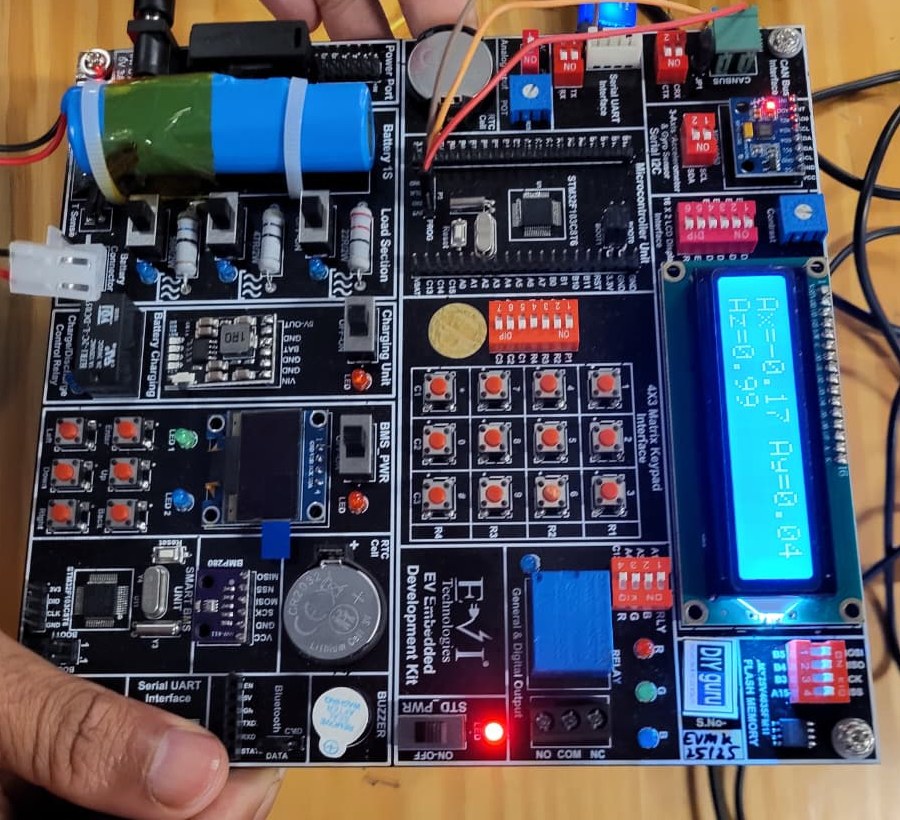
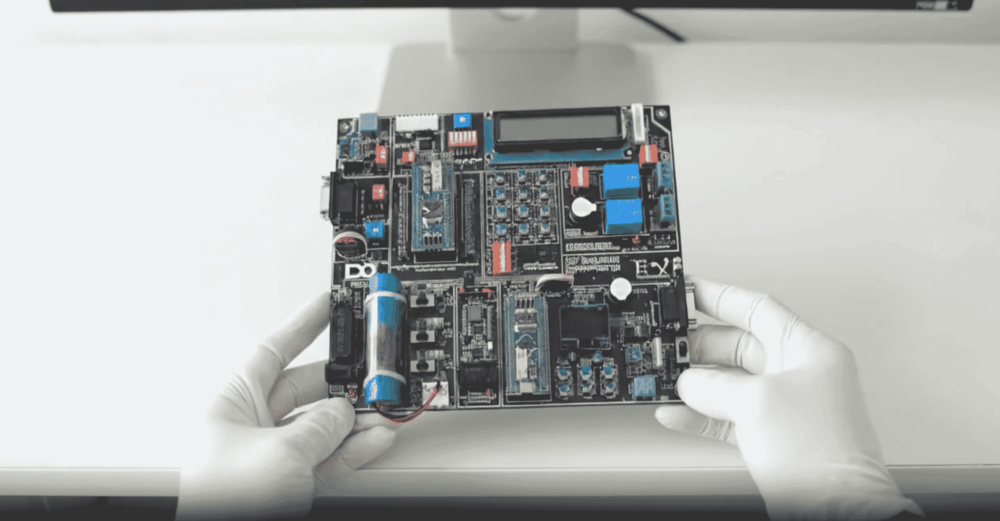
                  EV Embedded Development Kit board

                  Practise on real hardware

                  EV Embedded Development Kit

                  • STM32 controller and Smart BMS unit
                  • CAN, UART, I2C, SPI and Bluetooth
                  • Sensors, LCD, OLED and motor control
                  • 15+ guided experiments at home

                  ₹10,000 + GST

                  See what's in the kit

                  Trainer Support

                  Stuck on a concept? Ask a trainer.

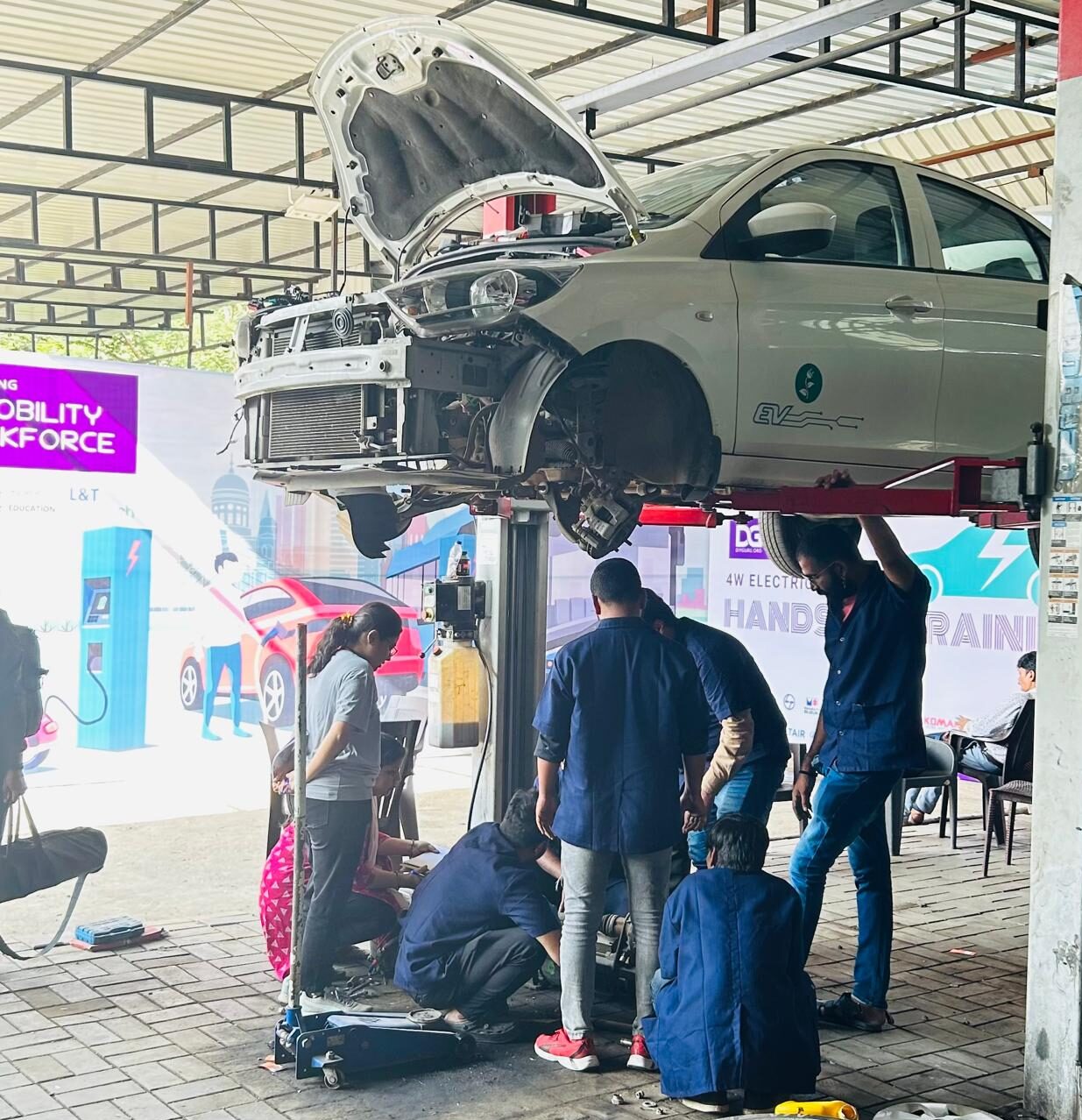
                  DIYguru trainer working with learners

                  Post doubts about UART DMA setup, CAN configuration, bit timing or two-board communication in the course Q&A on the portal and a trainer will answer. Including your CubeIDE configuration and the error you see helps trainers respond accurately.

                  • Ask questions in the course Q&A, right next to the lesson
                  • Trainers answer on the portal — you're notified when they reply
                  • Assignments and projects you submit are reviewed by a trainer
                  • Live doubt-clearing sessions when they're scheduled for the course

                  Bharat eMobility Recruitathon

                  Meet the EV industry in person

                  The Bharat eMobility Recruitathon brings our learners face to face with companies hiring across the EV industry. Watch the Delhi and Pune chapters.

                  Delhi chapterRecruitathon
                  Pune chapterRecruitathon

                  FAQ

                  Frequently asked questions

                  What are the prerequisites?
                  You should be comfortable with Embedded C and basic STM32 work in STM32CubeIDE, such as GPIO and timers. The course starts directly with UART projects.
                  Do I need hardware?
                  To follow the CAN projects on real hardware you need two STM32 boards with CAN support and two CAN transceiver modules, bought separately. No kit is included. You can still follow the lessons and code without hardware.
                  Which protocols are covered?
                  The recorded lessons cover UART (polling, callback, interrupt, DMA) and CAN (concepts, arbitration, frame structure, two-board communication). The course outline also lists standard and extended CAN frames, I2C, SPI, EEPROM and Bluetooth in automotive use.
                  Which software is used?
                  STM32CubeIDE, which is free, and a serial terminal such as Docklight for viewing UART output.
                  How do I get the certificate?
                  Complete the lessons and any required assessments. The certificate is digitally signed and verifiable through a public verification link or QR code.
                  Which programmes include this course?
                  It is part of the Advanced Nanodegree in Embedded Systems, the Professional Certification Programme in EV Embedded Systems and the PG Certificate Programme in EV & Embedded Systems.
                  How is the course delivered?
                  As recorded video lessons on the portal that you watch at your own pace, with quizzes, assignments and a project where the course includes them. Your progress is saved lesson by lesson.
                  What if I get stuck?
                  Ask in the course's Q&A on the portal — a trainer answers there. Live doubt-clearing sessions are added when they are scheduled for the course.
                  What certificate will I get?
                  A digitally signed certificate of completion once you finish the lessons and the required quizzes and assignments. Each certificate has a public verification link and QR code anyone can check.

                  Talk to a counsellor

                  Questions about Certification in Advanced Communication Applications Using ARM Cortex?

                  Leave your details — a counsellor will call you about the syllabus, fees, EMI and certificates.

                  Technical Expertise You Will Gain

                  Where Certification in Advanced Communication Applications Using ARM Cortex can take you

                  The roles these skills are used in, what you'll be able to do, and the parts of the industry that need it.

                  Key Job Roles

                  • →Embedded Software Engineer (communication stacks, junior)
                  • →Automotive CAN Integration Trainee
                  • →ECU Validation Engineer
                  • →Vehicle Network Test Engineer
                  • →Embedded Firmware Developer

                  Skill Sets

                  • →Implement UART transmit and receive on STM32 using polling, interrupts and DMA
                  • →Use HAL callbacks to handle serial events without blocking the main loop
                  • →Explain CAN controller and transceiver roles, CRC, differential signalling and message arbitration
                  • →Configure CAN on an STM32 and exchange frames between two boards
                  • →Identify the fields of a CAN data frame and distinguish standard from extended identifiers
                  • →Describe where I2C, SPI, EEPROM and Bluetooth are used in vehicle electronics

                  Where These Skills Are Used

                  • →EV and automotive ECU development
                  • →Battery management and charging systems
                  • →Vehicle diagnostics and telematics
                  • →Industrial automation using CAN networks
                  • →Two- and three-wheeler EV electronics

                  Government-Certified · Industry-Endorsed · Learner-Approved

                  Globally recognised credentials

                  ASDC (Govt of India)

                  ASDC (Govt of India)

                  Automotive Skills Development Council — recognised by major OEMs worldwide.

                  AICTE NEAT

                  AICTE NEAT

                  National Educational Alliance for Technology — issued under AICTE's premium learning ecosystem.

                  Learner Stories

                  What our learners say

                  The hardware-first approach made all the difference. Came in from a generalist electronics background; the BMS and motor-drive modules gave me concrete vocabulary I could carry into Infineon interviews.

                  Souvik Hazra
                  Souvik Hazra
                  Senior Manager · Infineon Technologies

                  Industry-grade depth without the academic ivory tower. The MATLAB Simulink + capstone defence prepared me for exactly the kind of cross-functional EV problems we solve at Cummins.

                  Sharad Yeola
                  Sharad Yeola
                  Application Controls Lead · Cummins Inc.

                  Started with electronics, walked into a BMS role in Germany. The applied projects + mentor reviews are what carried me through — the certifications opened the door, the depth got me hired.

                  Jagatjit Barik
                  Jagatjit Barik
                  Sr. R&D Engineer (BMS xEV) · Mercedes-Benz

                  Ready to start Certification in Advanced Communication Applications Using ARM Cortex?

                  Recorded lessons at your own pace · trainer doubt support · verifiable certificate on completion.
                  Accreditations

                  Programs Recognised by Govt. Bodies & Industries

                  ASDC
                  AICTE NEAT
                  SIMOPS Saudi
                  DSD Malaysia
                  UK Government
                  UACH
                  Tata Technologies
                  ADYPU
                  UDYOGA Karnataka
                  Ola Mobility Institute