
Electric vehicles add a new, flexible load to the electricity grid. Across India the extra energy is still small compared with total demand, but charging can strain local distribution transformers if many vehicles plug in at the evening peak. Managed well, with time-of-day tariffs, smart charging and in time vehicle-to-grid (V2G), EVs can instead help the grid absorb more solar power.
How much extra electricity do EVs need?
At national level the numbers are modest. India met an all-time peak demand of 270.82 GW on 21 May 2026, according to the Ministry of Power. By comparison, the India Energy Storage Alliance (IESA) estimated EV charging demand at about 4 TWh in FY2024-25, rising to about 38 TWh by FY2031-32, which it put at roughly 3% of the 2,133 TWh total demand projected in the National Electricity Plan for that year.
The real pressure is local and depends on timing. A housing society transformer sized for fans, lights and a few air conditioners can be overloaded if dozens of cars start charging at 7 pm, when household demand is already high. A depot charging 100 e-buses overnight needs its own high-voltage connection. That is why grid planners talk about where and when EVs charge more than how much.
Charging load by vehicle type
| Use case | Typical charger | Grid concern |
|---|---|---|
| Two- and three-wheelers at home | Portable or wall-mounted AC charger on a domestic socket | Small per vehicle; matters when many charge at once on one feeder |
| Cars at home or work | 7.4 to 22 kW AC wallbox | Evening clustering on residential transformers |
| Public fast charging | DC chargers, typically 30 kW upwards | Short, sharp peaks; needs a dedicated connection |
| E-bus and e-truck depots | DC chargers of 250 kW and above (PM E-DRIVE specifies 250 to 500 kW CCS-II for heavy vehicles) | Megawatt-scale load; often needs a new substation or line |
Smart charging and time-of-day tariffs
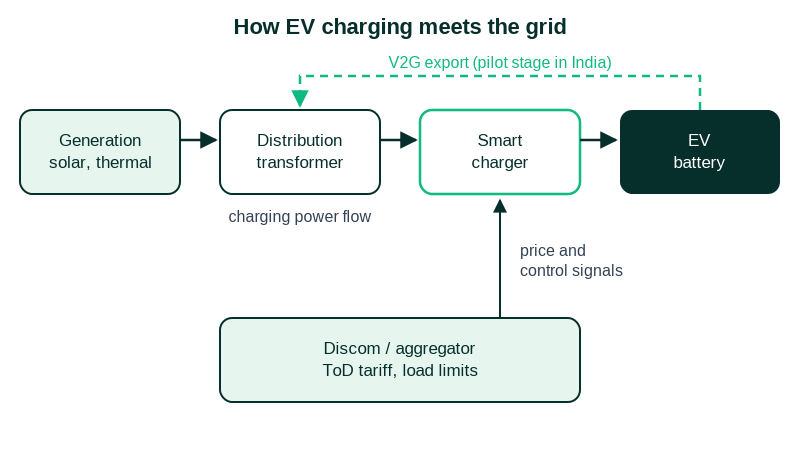
Smart charging means the charger, the vehicle or an operator's software decides when and how fast to charge, within limits set by the user and the utility. India has put the price signals in place:
- Time-of-day (ToD) tariffs: under the 2023 amendment to the Electricity (Rights of Consumers) Rules, solar-hour tariffs are 10 to 20% lower than the normal tariff and peak-hour tariffs 10 to 20% higher. ToD applied to commercial and industrial consumers of 10 kW and above from 1 April 2024, and to all other consumers except agriculture from 1 April 2025, taking effect as smart meters are installed.
- Charging-station tariffs: the Ministry of Power's Guidelines for Installation and Operation of EV Charging Infrastructure-2024 (17 September 2024) set a single-part tariff for public charging with lower rates during solar hours. Check your state electricity regulatory commission's current EV tariff order for exact rates.
- Load management: networked chargers can share a fixed connection between several vehicles, so a society can install more chargers without upgrading its supply.
EVs and solar power
Solar output peaks around midday, when many cars are parked at offices, depots and malls. Moving charging into those hours uses cheap daytime solar power and reduces evening peaks. The Central Electricity Authority's 2023 report on V2G services makes the same point, recommending mid-day charging at workplaces and commercial premises and pre-cabling for smart chargers in commercial buildings. Solar-plus-storage stations are also appearing: BESCOM's EV Hub in Bengaluru opened a station in June 2025 combining 45 kWp of rooftop solar with a 100 kWh battery built from repurposed EV batteries.
Vehicle-to-grid (V2G)
V2G lets a parked EV send energy back to the grid or a building when needed. The CEA notes that vehicles are parked 80 to 90% of the time and could act as flexible loads and distributed storage, providing services such as peak shaving and congestion relief through aggregators. It recommends standard, open communication protocols, changes to Indian standards and grid-connectivity rules for reactive power.
In India V2G is at the pilot stage. There is no settled way to pay EV owners for exported energy, and frequent cycling raises battery-ageing questions that manufacturers must cover in their warranties.
What the grid needs next
- Distribution upgrades: transformer and feeder capacity in areas where EV use clusters, planned with discom data.
- Fast connections: the 2024 guidelines set timelines for discoms to energise charging connections, from a few days in metro areas to longer in rural and hilly regions.
- Visibility: the government reported 52,718 public charging stations on the BHEL portal in July 2026, up from 29,151 reported in December 2025. Utilities need that data at feeder level to plan.
- Power quality: large clusters of chargers can add harmonics and voltage swings, so chargers must meet power-quality limits.
Frequently asked questions
Will EVs cause power cuts in India?
Not at national level in the near term; EV charging is a small share of total demand. Local overloads are possible where many vehicles charge on one transformer at peak time, which is why smart charging and ToD tariffs matter.
Is it cheaper to charge my EV during the day?
Often, yes, if you are on a ToD tariff and your discom offers lower solar-hour rates. Check your bill or your state commission's tariff order.
Can I sell power from my EV back to the grid?
Not routinely yet. V2G in India is limited to pilots and studies, and a payment mechanism for owners is still to be set up.
Grid integration is a growing field for electrical engineers. Read our guide to e-mobility for the bigger picture, look up terms in the EV glossary, or explore EV courses that cover charging and power systems.
Sources: News On AIR — India's electricity demand hits record 270.82 GW; Energetica India — IESA report predicts operational EVs to cross 28 million by 2030; PIB — Time of Day tariff and smart metering rules (23 June 2023); Mercom India — CEA recommends measures for EV-to-grid charging; ThePrint — India's first solar-powered, second-life battery EV charging station in Bengaluru; PIB — Charging stations for electric vehicles (21 July 2026). Updated 15 November 2026.