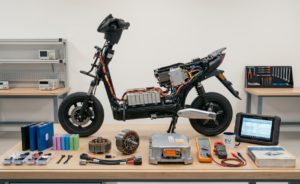
Introduction: Why Electric Vehicle Courses Matter Today
The global automotive industry is undergoing its most significant transformation in over a century. With governments pushing for cleaner technologies, climate change concerns rising, and fossil fuel dependency becoming unsustainable, electric vehicles (EVs) are no longer just a futuristic idea—they are today’s reality.
According to the International Energy Agency (IEA), EV sales crossed 14 million units worldwide in 2023, representing 18% of total car sales. Countries like China, the US, Germany, and India are investing heavily in EV adoption, charging infrastructure, and battery manufacturing. India itself has set an ambitious target under its EV2030 roadmap to achieve 30% electrification of its mobility sector by 2030.
But while demand is rising, there is a massive skills gap. Companies—from startups to established OEMs—struggle to find qualified engineers, technicians, and researchers who can design, build, and maintain electric mobility systems. The EV sector is projected to create 10 million direct jobs and 50 million indirect jobs in India by 2030, but the industry reports that most graduates are not industry-ready.
This is where specialized EV courses like those offered by DIYguru step in. Unlike conventional automotive engineering programs that are often theory-heavy and slow to adapt, DIYguru’s programs are industry-aligned, project-driven, and placement-focused. They bridge the gap between academic knowledge and real-world EV engineering needs.
The Changing Nature of Automotive Careers
Traditional automotive careers revolved around internal combustion engine (ICE) design, fuel efficiency optimization, and mechanical servicing. These skills, while still valuable, are rapidly becoming obsolete as automakers phase out ICE vehicles and governments introduce bans on petrol/diesel cars in the next 10–15 years.
In contrast, future automotive engineers must master new domains such as:
- Battery pack development & BMS (Battery Management Systems)
- Power electronics & electric motor drives
- Embedded systems, software integration, and diagnostics
- Charging infrastructure and smart grid integration
- Sustainability, recycling, and lifecycle emissions management
Without structured training in these areas, engineers risk being left behind. DIYguru’s EV courses are specifically designed to future-proof careers by equipping learners with next-generation skills.
Overview of DIYguru’s Electric Vehicle Programs
DIYguru, India’s pioneering EV upskilling platform, offers a range of programs for students, professionals, and technicians. These programs are delivered online, hybrid, or via hands-on workshops and are supported by industry partnerships with IIT Guwahati (E&ICT Academy), Tata Technologies, ADYPU Pune, Sonalika, BGauss, Mahindra, and Wipro Engineering Edge.
1. Postgraduate Program in Electric Vehicle Technology (Flagship Program)
- Duration: 12 months (online + hybrid workshops)
- Certification: Jointly issued by IIT Guwahati E&ICT Academy + DIYguru
- Partner: Tata Technologies (provides EV lab content & industry modules)
- Modules Covered:
- Introduction to EV Technology
- Battery Systems & BMS
- Power Electronics & Motor Drives
- Charging Infrastructure & Standards
- Embedded Systems for EVs
- Thermal Management Systems
- Safety Standards & Compliance
- Vehicle Integration & Digital Twin Simulations
- Sustainability & Recycling
This program is targeted at engineering graduates and working professionals who want to transition into core EV engineering roles. It combines live classes, self-paced modules, labs, and a final capstone project evaluated by industry experts.
💡 Placement Support: Graduates get career assistance through emobility.careers, DIYguru’s EV-exclusive job portal, which connects them with OEMs, startups, and tier-1 suppliers.
2. Nanodegree Certification in EV Engineering (Skill-Focused Program)
- Duration: 6 months
- Certification: DIYguru + Optional Tata Technologies (₹10,000 extra)
- Focus: Provides short-term specialization in EV essentials—battery tech, BMS, charging, and motors.
- Audience: Working professionals from automotive, mechanical, electrical, or electronics backgrounds who want to upskill without committing to a year-long program.
💡 This course is modular and flexible, making it ideal for engineers who want to transition into the EV industry while continuing their jobs.
3. EV Technician & Service Program
- Duration: 3 months
- Certification: DIYguru + Optional Tata Technologies (₹6,000 extra)
- Focus: Practical training for service center technicians, mechanics, and diploma graduates.
- Modules:
- EV fundamentals
- Battery diagnostics & troubleshooting
- Motor and controller repair
- Charging system servicing
- Safety procedures for high-voltage handling
💡 This program fills a critical workforce gap by producing skilled service engineers for India’s expanding EV servicing ecosystem.
4. Hands-On EV Workshops
- Duration: 5–10 days
- Location: DIYguru centers in Delhi, Pune, and other metro cities
- Structure: Students work directly on vehicles like Mahindra e-Verito, electric two-wheelers, and battery packs.
- Activities Include:
- EV teardown and reassembly
- Battery pack assembly and balancing
- Thermal management experiments
- Real-time diagnostics with industry tools
💡 These workshops are especially popular among college students, startups, and entrepreneurs who want practical, lab-based exposure.
5. Global Collaborations and Online Modules
In addition to Indian collaborations, DIYguru is expanding partnerships with universities and companies in Germany, Japan, the UK, and Canada. This allows students to access globally benchmarked EV training, making their careers internationally relevant.
Why DIYguru Stands Out
Unlike many EdTech providers that offer generic “EV courses,” DIYguru has built a comprehensive ecosystem around EV education:
- Industry-Aligned Curriculum
- Designed with input from Tata Technologies, Mahindra, and Sonalika.
- Continuously updated based on industry requirements.
- Placement Ecosystem
- Integrated with emobility.careers, India’s only EV-focused job portal.
- Strong corporate tie-ups for direct recruitment.
- Flexible Learning Paths
- PG programs for graduates.
- Nano certifications for working professionals.
- Technician programs for diploma holders.
- Workshops for hands-on learners.
- Strong Academic-Industry Partnerships
- Joint certifications with IIT Guwahati (E&ICT Academy).
- Training content from Tata Technologies’ EV labs.
- Practical, Job-Oriented Projects
- EV retrofitting projects.
- Battery pack design simulations.
- Real-world charging infrastructure projects.
- Capstone projects reviewed by OEM experts.
Why Learn EV Engineering Now?
- Job Market: India’s EV industry alone is projected to reach ₹50,000 crore by 2030. Every OEM and Tier-1 supplier is actively hiring EV engineers.
- Government Push: Subsidies, FAME-II policies, and state-level incentives make EV adoption unstoppable.
- Global Demand: EV engineers are in demand not just in India but also in Europe, North America, and East Asia.
- Future-Proof Career: Unlike ICE-focused roles, EV engineers will continue to remain relevant as the automotive industry transitions.
Detailed Subject-Wise Breakdown
The DIYguru Electric Vehicle (EV) programs are designed around a set of core subjects that reflect the skills most in demand in today’s automotive industry. These subjects are not taught in isolation but are integrated into a hands-on, application-driven learning path. Let’s explore each subject in detail.
1. Introduction to Electric Vehicles
Before diving into advanced modules, every student starts with the foundational concepts of EVs.
Topics Covered:
- Evolution of EVs: From 19th-century prototypes to Tesla, Tata, and BYD.
- EV ecosystem: OEMs, Tier-1 suppliers, battery manufacturers, and charging providers.
- Types of EVs: Battery Electric Vehicles (BEVs), Plug-in Hybrid Electric Vehicles (PHEVs), Hybrid Electric Vehicles (HEVs), and Fuel Cell EVs.
- Policy and regulations: India’s FAME-II scheme, global bans on ICE vehicles, and safety standards.
- Market trends: Projections for India (10M jobs by 2030) and global EV adoption.
Why It Matters:
This subject sets the stage, ensuring that students understand the bigger picture of the EV industry before they specialize.
Real-World Example:
- India’s EV adoption target of 30% by 2030 makes this knowledge critical for engineers, entrepreneurs, and policymakers alike.
2. Battery Technology & Energy Storage Systems
The battery pack is the heart of an EV, accounting for 30–40% of the total vehicle cost. Mastering batteries is essential for any EV professional.
Topics Covered:
- Lithium-ion battery chemistry (LFP, NMC, NCA, solid-state batteries).
- Battery selection parameters: energy density, cycle life, C-rate, and safety.
- Cell construction: cylindrical, prismatic, pouch cells.
- Energy and power trade-offs: choosing between high energy density vs high power output.
- Battery degradation: causes, prevention, and lifecycle extension.
- Recycling technologies and second-life applications.
Why It Matters:
Battery expertise directly translates into careers as Battery Engineers or Energy Storage Specialists.
Real-World Example:
- Tata Motors Nexon EV uses LFP chemistry for better safety and cost optimization in Indian conditions.
- Tesla is pioneering 4680 cylindrical cells for higher density and reduced cost.
3. Battery Management Systems (BMS)
A Battery Management System is like the brain of an EV battery. It monitors, protects, and optimizes the pack.
Topics Covered:
- Functions of BMS: SOC (State of Charge), SOH (State of Health), balancing, and safety cut-offs.
- Types of BMS: centralized, modular, distributed.
- Cell balancing techniques: passive vs active.
- Communication protocols: CAN bus, LIN bus.
- Fault detection: overcharge, deep discharge, short-circuit prevention.
- BMS safety standards (ISO 26262, IEC standards).
Why It Matters:
A faulty BMS can cause thermal runaway and fires. Every EV company hires BMS specialists.
Real-World Example:
- In 2022, several Indian EV scooters (Ola, Pure EV) caught fire due to battery pack thermal runaway caused by poor BMS design. Skilled engineers can prevent such failures.
4. Power Electronics and Motor Drives
Power electronics is the nervous system of EVs—converting, controlling, and directing electrical power to motors.
Topics Covered:
- Inverters: converting DC battery power to AC for motors.
- Converters: DC-DC step-up and step-down converters.
- Motor controllers: ensuring smooth acceleration, regenerative braking.
- Efficiency optimization: pulse-width modulation (PWM), vector control.
- Protection circuits: for overcurrent and overheating.
Motor Technologies Covered:
- BLDC (Brushless DC Motors): common in scooters and small EVs.
- PMSM (Permanent Magnet Synchronous Motors): used in Tesla, BYD, Hyundai EVs.
- Induction Motors: used in early Tesla Model S due to robustness.
Why It Matters:
Motor & power electronics expertise is vital for EV drivetrain engineers.
Real-World Example:
- Ola S1 scooter uses a PMSM motor with a customized controller for high torque.
- Tesla Model 3 uses a combination of induction and PMSM motors for efficiency and performance balance.
5. Charging Infrastructure & Smart Grids
No EV revolution is possible without charging infrastructure.
Topics Covered:
- Types of charging:
- AC slow charging (Level 1, Level 2).
- DC fast charging (Level 3, CCS, CHAdeMO).
- Wireless charging (inductive pads).
- Charging protocols: CCS2 (India’s standard), Bharat DC-001, Tesla Supercharger.
- Smart charging systems: V2G (vehicle-to-grid) technology.
- Grid integration challenges: load management, renewable energy integration.
- Business models: public charging stations, home charging, subscription models.
Why It Matters:
Charging engineers are needed for both urban charging networks and rural EV adoption.
Real-World Example:
- Tata Power and Fortum India are building fast-charging corridors across highways.
- Tesla’s Supercharger V3 provides 250 kW charging, adding 300 km range in 15 minutes.
6. Embedded Systems & Software Integration
Modern EVs are software-driven machines.
Topics Covered:
- Microcontroller systems: STM32, TI processors.
- AFE (Analog Front-End) hardware: for voltage/current sensing.
- CAN bus protocols for EV communication.
- Embedded C programming for control systems.
- Diagnostic algorithms for real-time fault detection.
Why It Matters:
EVs now require engineers who understand both hardware and software integration.
Real-World Example:
- Ola, Ather, and Tesla use over-the-air (OTA) software updates to improve EV performance post-purchase.
7. Thermal Management Systems
EV components—especially batteries and motors—generate significant heat. Proper cooling ensures safety and longevity.
Topics Covered:
- Heat transfer modes: conduction, convection, radiation.
- Cooling strategies: air cooling, liquid cooling, PCM (Phase Change Material).
- Motor cooling systems: jacket cooling, spray cooling.
- Thermal runaway prevention.
Why It Matters:
Battery fires are one of the biggest risks in EVs. Engineers trained in thermal management can prevent disasters.
Real-World Example:
- BYD Blade battery is engineered with a unique thermal design that prevents fires even when punctured.
8. Vehicle Integration & Digital Simulation
A vehicle is not just a sum of parts; it’s a system of systems.
Topics Covered:
- Cell-to-pack ratio optimization.
- Packaging challenges: space, weight, and cost optimization.
- Crash safety considerations.
- Digital Twin simulation: using MATLAB/Simulink, ANSYS, MSC Adams for testing designs virtually before physical prototypes.
Why It Matters:
System-level engineers ensure the entire EV functions seamlessly.
Real-World Example:
- BMW i4 was virtually tested with digital twin models before real-world prototypes, saving millions in R&D.
9. EV Safety & Standards
High-voltage systems demand strict safety protocols.
Topics Covered:
- High-voltage safety: lockout-tagout (LOTO) procedures.
- Global standards: ISO 26262 (functional safety), AIS standards (India).
- Arc flash studies and personal protective equipment (PPE).
- Crash safety and battery enclosure design.
Why It Matters:
Regulations ensure EVs meet global safety requirements—essential knowledge for compliance engineers.
Real-World Example:
- Indian EV fires in 2022 led to government-mandated AIS-156 standard updates for battery packs.
10. Sustainability & Recycling
EVs are not automatically sustainable unless end-of-life recycling is addressed.
Topics Covered:
- Lifecycle assessment (LCA): cradle-to-grave emissions.
- Battery recycling technologies: pyrometallurgical, hydrometallurgical methods.
- Second-life applications: using EV batteries in stationary storage.
- Circular economy strategies.
Why It Matters:
Companies need engineers who understand eco-friendly design and compliance with ESG mandates.
Real-World Example:
- Redwood Materials (US) and Attero Recycling (India) are scaling up EV battery recycling, creating green jobs.
11. Capstone Projects & Labs
Every DIYguru program includes projects that simulate real-world challenges.
Examples of Projects:
- Designing a 48V lithium-ion battery pack.
- Creating a BMS simulation in MATLAB.
- Retrofitting an ICE car to an EV.
- Building a digital twin of an EV drivetrain.
- Conducting a failure analysis of a battery pack.
Why It Matters:
Hands-on projects ensure learners are job-ready, not just academically certified.
Electric Vehicle Topics in Detail
Beyond the subject modules, DIYguru’s EV programs break down into specialized topics that reflect the skills engineers need in real-world applications. Each topic is taught through theory + simulation + projects, ensuring both depth and practice.
1. Battery Pack Design
What It Is:
Battery pack design is the process of integrating cells into a safe, high-performing, and cost-effective unit. It determines energy capacity, efficiency, and range of an EV.
Key Aspects:
- Series vs parallel cell connections.
- Cell-to-pack ratio optimization.
- Cooling integration within packs.
- Structural design and safety enclosures.
- Energy vs power trade-offs for different vehicle classes (2W vs 4W vs buses).
Real-World Relevance:
- Tesla’s 4680 cell-to-pack strategy reduces weight and cost.
- Tata Motors uses prismatic cells for compact design in Nexon EV.
Career Role: Battery Pack Engineer or Thermal Design Engineer.
2. Cell Balancing
What It Is:
Cell balancing ensures all cells in a pack discharge and recharge evenly, avoiding stress on weaker cells.
Key Aspects:
- Passive balancing: using resistors to discharge excess energy.
- Active balancing: redistributing charge between cells.
- SOC (State of Charge) monitoring.
- Software-controlled balancing algorithms.
Real-World Relevance:
- Poor balancing caused several EV scooter fires in India (2022).
- Ather Energy’s scooters gained reputation for reliable battery life due to robust balancing systems.
Career Role: BMS Engineer.
3. Thermal Management
What It Is:
Manages heat in batteries, motors, and controllers to prevent overheating and fire hazards.
Key Aspects:
- Heat transfer modeling (conduction, convection, radiation).
- Cooling methods: air cooling, liquid cooling, PCM (phase change materials).
- Thermal runaway prevention mechanisms.
- Sensor integration for predictive cooling.
Real-World Relevance:
- BYD’s Blade Battery passed the nail penetration test without catching fire.
- Ola upgraded cooling systems after multiple fire incidents.
Career Role: Thermal Systems Engineer.
4. Charging Systems
What It Is:
Charging systems determine how fast and efficiently EVs replenish energy.
Key Aspects:
- AC vs DC charging.
- CCS2, CHAdeMO, Bharat EV protocols.
- Fast-charging technologies (up to 350 kW).
- Wireless inductive charging.
- V2G (Vehicle-to-Grid) bi-directional systems.
Real-World Relevance:
- Tesla’s Supercharger network added 300 km of range in just 15 minutes.
- Tata Power building highway charging corridors in India.
Career Role: Charging Infrastructure Engineer.
5. Power Electronics & Motor Control
What It Is:
Power electronics convert energy from the battery into usable power for motors.
Key Aspects:
- Inverters (DC to AC).
- DC-DC converters (voltage step-up/step-down).
- Motor controllers and torque control.
- Regenerative braking.
Real-World Relevance:
- Ola S1 Pro scooter uses PMSM motor with vector control for smooth acceleration.
- Tesla Model 3 uses silicon-carbide inverters for higher efficiency.
Career Role: Motor Drive Engineer.
6. Digital Twin & Simulation
What It Is:
A digital twin is a virtual model of an EV system, used for testing before building real prototypes.
Key Aspects:
- MATLAB/Simulink for BMS modeling.
- ANSYS Fluent for thermal simulations.
- MSC Adams for drivetrain dynamics.
- Failure Mode Effect Analysis (FMEA).
Real-World Relevance:
- BMW i4 and Ola scooters tested designs virtually before physical rollout.
- Saves millions in R&D costs and speeds up innovation.
Career Role: Simulation Engineer.
7. EV Safety Protocols
What It Is:
Safety ensures EV systems operate under high-voltage conditions without risk to users.
Key Aspects:
- Lockout-Tagout (LOTO) for servicing.
- Safety standards: ISO 26262, AIS-156, OSHA, NFPA 70E.
- Battery enclosure crash safety.
- Arc flash protection and PPE training.
Real-World Relevance:
- After scooter fire incidents, Indian govt mandated AIS-156 compliance.
- Tesla’s Model S earned 5-star Euro NCAP safety rating due to rigorous testing.
Career Role: EV Safety & Compliance Engineer.
8. EV Sustainability & Recycling
What It Is:
Sustainability ensures EVs reduce lifecycle emissions and batteries don’t end up as toxic waste.
Key Aspects:
- Lifecycle Analysis (LCA): cradle-to-grave emissions of EVs vs ICE.
- Recycling: hydrometallurgical and pyrometallurgical methods.
- Second-life applications: using EV batteries in solar/wind storage.
- Circular economy in EV manufacturing.
Real-World Relevance:
- Attero Recycling (India) is recovering lithium, cobalt, and nickel from old batteries.
- Redwood Materials (US) supplies recycled materials back to EV companies.
Career Role: Sustainability Engineer or EV Recycling Specialist.
9. Embedded Systems in EVs
What It Is:
Embedded systems connect hardware and software, making EVs smart and safe.
Key Aspects:
- CAN Bus communication.
- STM32 microcontrollers for BMS.
- Real-time monitoring with sensors.
- OTA (Over-the-Air) updates.
Real-World Relevance:
- Tesla updates acceleration modes and range with software patches.
- Ola’s MoveOS 3 introduced features via OTA.
Career Role: Embedded Systems Engineer.
10. EV Diagnostics & Maintenance
What It Is:
Diagnosing and repairing EVs requires specialized skills.
Key Aspects:
- OBD (On-Board Diagnostics) systems for EVs.
- Predictive maintenance with AI.
- Common failure analysis in motors and batteries.
- Tools: thermal cameras, battery testers, diagnostic laptops.
Real-World Relevance:
- EV service centers like EV.CARE are emerging across India to fill this gap.
Career Role: EV Technician or Field Engineer.
Fun Fact ⚡
Did you know? While EVs are known for lower maintenance, battery replacement can cost 40–50% of the car’s value. That’s why engineers specializing in battery longevity and diagnostics are in extremely high demand.
Part 4: Program Comparisons, Prerequisites, and Careers
Comparison of the Best EV Programs
With the rapid growth of EV education, learners often face confusion: Which EV course should I choose? DIYguru offers multiple formats to fit different needs — from PG Certifications for graduates to Nano certifications for professionals, and technician programs for service roles.
Here’s a comparison:
| Program | Duration | Best Suited For | Key Highlights | Certification |
|---|---|---|---|---|
| PG Certification in EV Technology (DIYguru + IIT Guwahati E&ICT) | 12 months | Engineering graduates & working professionals | Comprehensive 15-course structure, industry projects with Tata Tech, placement support | Joint certificate from IIT Guwahati + DIYguru |
| Nano Certification in EV Engineering | 6 months | Mid-level professionals transitioning into EV roles | Modular short-term program, optional Tata Tech certificate | DIYguru + optional Tata Tech (₹10,000) |
| EV Technician / Service Program | 3 months | Diploma holders, mechanics, service professionals | Hands-on diagnostic & repair training, high-voltage safety modules | DIYguru + optional Tata Tech (₹6,000) |
| Hands-On EV Workshop | 5–10 days | College students, startups, enthusiasts | Practical teardown, retrofitting, and lab experience | DIYguru |
💡 Conclusion: For those aiming for career transitions or placements, DIYguru’s programs offer more depth, certifications, and direct hiring support.
Prerequisites & Who Should Join
Not all learners come from the same background. DIYguru’s EV courses are tiered to include everyone from B.Tech students to experienced engineers.
1. Students (Final-Year or Fresh Graduates)
- Recommended Course: PG Program in EV Technology
- Prerequisites: Basic knowledge of electrical/mechanical engineering.
- Benefit: Builds a career-ready foundation with industry exposure + IIT recognition.
2. Working Professionals
- Recommended Course: Nano Certification in EV Engineering
- Prerequisites: Degree in Mechanical, Electrical, Electronics, or related fields.
- Benefit: Transition into high-paying EV roles while continuing their current job.
3. Diploma Holders / Technicians
- Recommended Course: EV Technician Program
- Prerequisites: ITI/Diploma, interest in EV servicing.
- Benefit: Quick entry into the growing EV service ecosystem.
4. Entrepreneurs & Startups
- Recommended Course: Workshops / PG Program
- Prerequisites: None (basic engineering literacy preferred).
- Benefit: Build products, retrofit ICE vehicles, or start EV ventures.
Career Opportunities & Job Market
The EV industry is not just a career opportunity — it’s a career revolution.
1. In India
- EV sales projected to reach 10 million annually by 2030.
- Govt support via FAME-II, PLI schemes, state subsidies.
- Estimated 10 million direct jobs + 50 million indirect jobs in EV by 2030.
2. Globally
- US, Germany, and China hiring battery & BMS engineers at premium salaries.
- EU mandates all new cars must be zero-emission by 2035, fueling demand.
Top Careers After DIYguru EV Courses
- Battery Engineer – Designing and testing battery packs.
- BMS Engineer – Building intelligent battery management systems.
- EV Design Engineer – Integrating motors, controllers, and packs.
- Charging Infrastructure Engineer – Developing smart grids & charging stations.
- Power Electronics Engineer – Optimizing inverters and converters.
- EV Service Technician – Diagnosing and repairing EVs at service centers.
- Sustainability Specialist – Working in recycling and green compliance.
Salary Insights
| Role | India (Avg Annual) | Global (Avg Annual) |
|---|---|---|
| Battery Engineer | ₹6–10 LPA | $80,000–$120,000 |
| BMS Engineer | ₹7–12 LPA | $90,000–$130,000 |
| EV Design Engineer | ₹8–14 LPA | $85,000–$125,000 |
| Charging Infra Engineer | ₹6–9 LPA | $70,000–$110,000 |
| EV Service Technician | ₹2–4 LPA | $35,000–$50,000 |
| Simulation Engineer | ₹9–15 LPA | $95,000–$140,000 |
💡 Note: Salaries depend on experience, location, and employer. With DIYguru’s IIT + Tata Tech-backed certification, learners can command higher pay packages.
FAQs About EV Courses
1. Is pursuing an EV course a good career path?
Yes. EVs are the future of mobility. India’s policy shift and global bans on petrol/diesel cars ensure long-term demand for EV engineers.
2. Do I need to be from an engineering background to join?
For PG/Nano certifications, yes (Mechanical, Electrical, ECE, Mechatronics). For Technician programs/workshops, non-engineers can also enroll.
3. How long does it take to become job-ready?
- PG Program: 12 months.
- Nano Program: 6 months.
- Technician Program: 3 months.
4. Is coding required in EV engineering?
Basic coding (MATLAB, Embedded C, Python) helps in simulation & BMS development, but not mandatory for all roles.
5. What is the global scope of DIYguru’s certificate?
The joint IIT Guwahati + DIYguru certificate is recognized internationally. Tata Technologies’ involvement adds strong industry credibility.
6. Can I study EV courses online?
Yes. DIYguru offers online + hybrid models with optional hands-on workshops at centers in Delhi/Pune.
7. What is the cost of DIYguru EV programs?
- PG Program: ₹1,49,000.
- Nano Program: ₹79,000.
- Technician Program: ₹45,000.
- Workshop: ₹15,000–₹30,000.
8. How is DIYguru different from competitors?
DIYguru offers job guarantee pathways, IIT recognition, Tata Tech collaboration, and practical labs, unlike purely theory-based courses.
9. What kind of companies hire EV graduates?
- OEMs: Tata Motors, Mahindra, Ola Electric, Ather Energy, Hero Electric.
- Tier-1s: Bosch, Continental, Valeo, Wipro Engineering Edge.
- Startups: Ultraviolette, Euler Motors, Bounce Infinity.
10. Can entrepreneurs benefit from DIYguru EV courses?
Yes. Many startup founders (retrofitters, charging infra developers) have completed DIYguru courses to build credibility and technical depth.
Conclusion
The automotive industry is at a turning point. The shift from ICE to EVs is not just technological but economic, social, and environmental. For students, professionals, technicians, and entrepreneurs, the EV revolution offers opportunities unlike anything in the past 50 years.
DIYguru’s EV programs — in collaboration with IIT Guwahati and Tata Technologies — stand out as India’s most comprehensive, practical, and industry-relevant courses. With a combination of online learning, hands-on labs, and placement support, these programs ensure that learners are not just certified but also employable and future-ready.
For anyone looking to transition into EV careers, start an EV business, or stay relevant in the new mobility era, DIYguru’s EV programs provide the perfect launchpad.
🚀 Final Thought:
The EV industry isn’t waiting. Those who skill up today will lead tomorrow’s mobility revolution.