Description
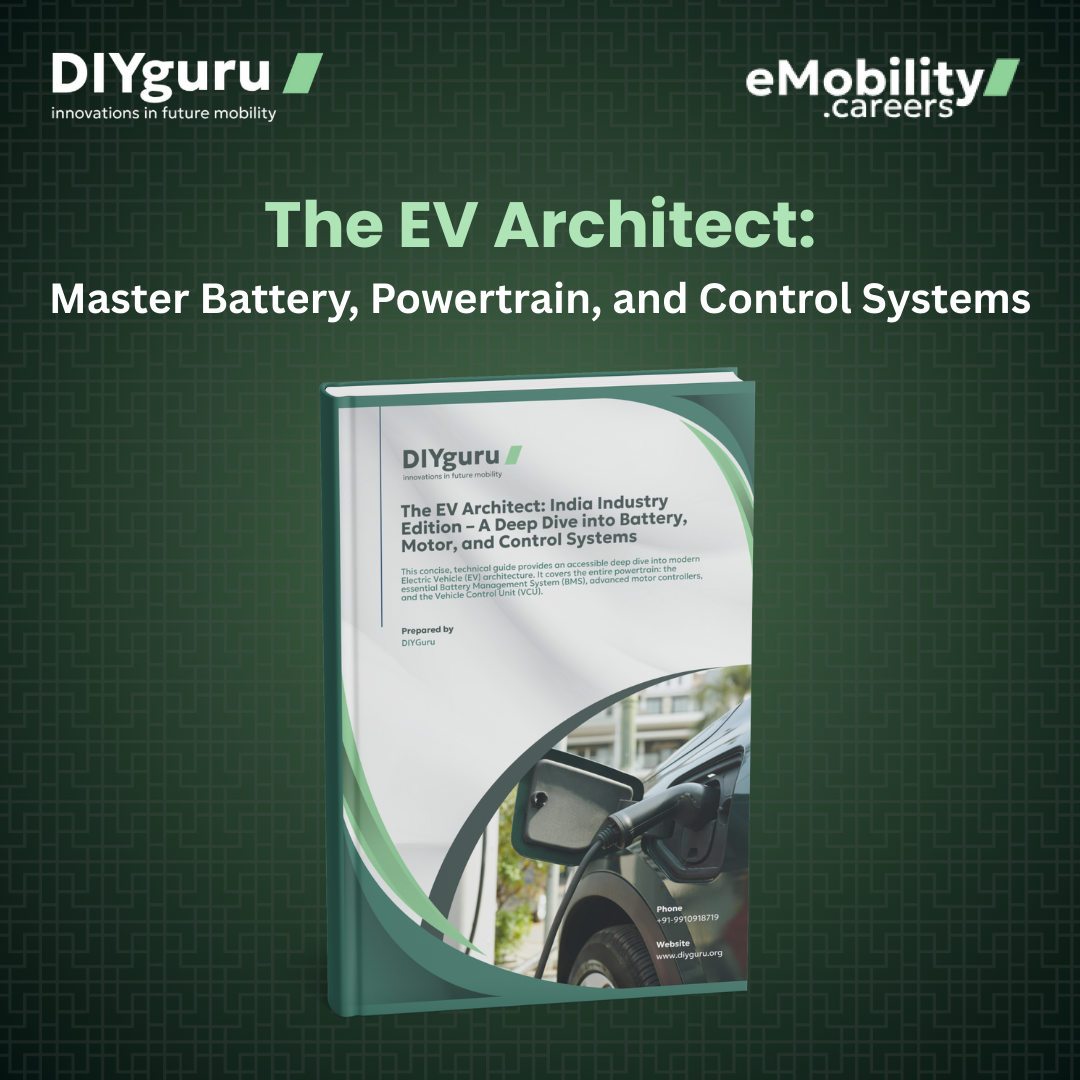
The EV Architect
Master Battery, Motor & EV Control Systems
The future of mobility belongs to those who understand the engineering behind it.
Modern EVs are built on smart architecture—a synergy of battery systems, motor control, power electronics, thermal management, and a VCU that syncs everything seamlessly.
This guide decodes it all — in a structured, India-focused, and industry-ready format.
Whether you’re an engineer, technician, EV startup founder, or student — this handbook gives you system-level clarity and career-relevant EV knowledge.
What Makes This Guide Different?
Unlike generic EV resources that only explain components, The EV Architect gives you architecture-level understanding—how the battery, motor controller, BMS, and VCU work together in real Indian EVs like Tata Nexon EV, BYD Seal, Hyundai Kona, and MG ZS.
Built on 2024–2025 data, regulations, climate, and charging ecosystem
Covers design logic, integration flow, performance metrics, and Indian use cases
Structured for industry readiness, technical interviews, and real-world application
What You’ll Learn
Module 1: Fundamentals of EV Architecture (India Context)
- India EV market trends and vehicle segmentation
- BEV vs. HEV vs. PHEV — selecting the right drivetrain
- High-voltage vs. low-voltage frameworks — safety, compliance, and standards
- Powertrain block diagram, PDU, and system flow
Module 2: Battery & BMS Engineering
- Cell chemistry and pack design for Indian climatic conditions
- BMS functions — SOC, SOH, balancing, protection logic
- Wireless BMS, modular architectures, and thermal management
- TMS challenges in hot Indian environments
Module 3: Power Controllers & Charging Architecture
- SiC & IGBT-based inverter technology
- How Field-Oriented Control (FOC) enables smooth torque delivery
- Motor controller design, sizing, cooling, insulation
- Onboard charger, DC-DC converter, and Indian charging standards (CCS2/Bharat DC)
Module 4: Propulsion, Sensors & VCU
- Motor types for Indian EVs — PMSM, BLDC, induction
- Torque-speed characteristics: continuous vs peak power
- Smart sensors, actuators & safety feedback loops
- VCU functions, CAN communication, and regenerative braking logic
Module 5: Future EV Architecture Technologies
- Lightweight materials & structural safety
- Software-Defined Vehicle, OTA updates, and cybersecurity
- Grid integration (V2G), pantograph charging & high-power DC fast charging
Who Should Use This Guide?
| Ideal For | Why It Helps |
| EV Design Engineers | System-level clarity for design/integration |
| Technicians & Service Experts | Diagnose and explain EV architecture faults |
| Engineering Students | Interview prep with real-world architecture concepts |
| EV Startups & Managers | Build product, service & technology roadmaps |
Real Impact — Beyond Just Learning
Faster interview conversions
Better understanding of real EV systems
Improved EV troubleshooting skills
Confidence in technical discussions and EV projects
Get Instant Access
Become an EV Systems Expert
Need corporate or bulk licensing?
Chat with us for enterprise access or classroom integration.