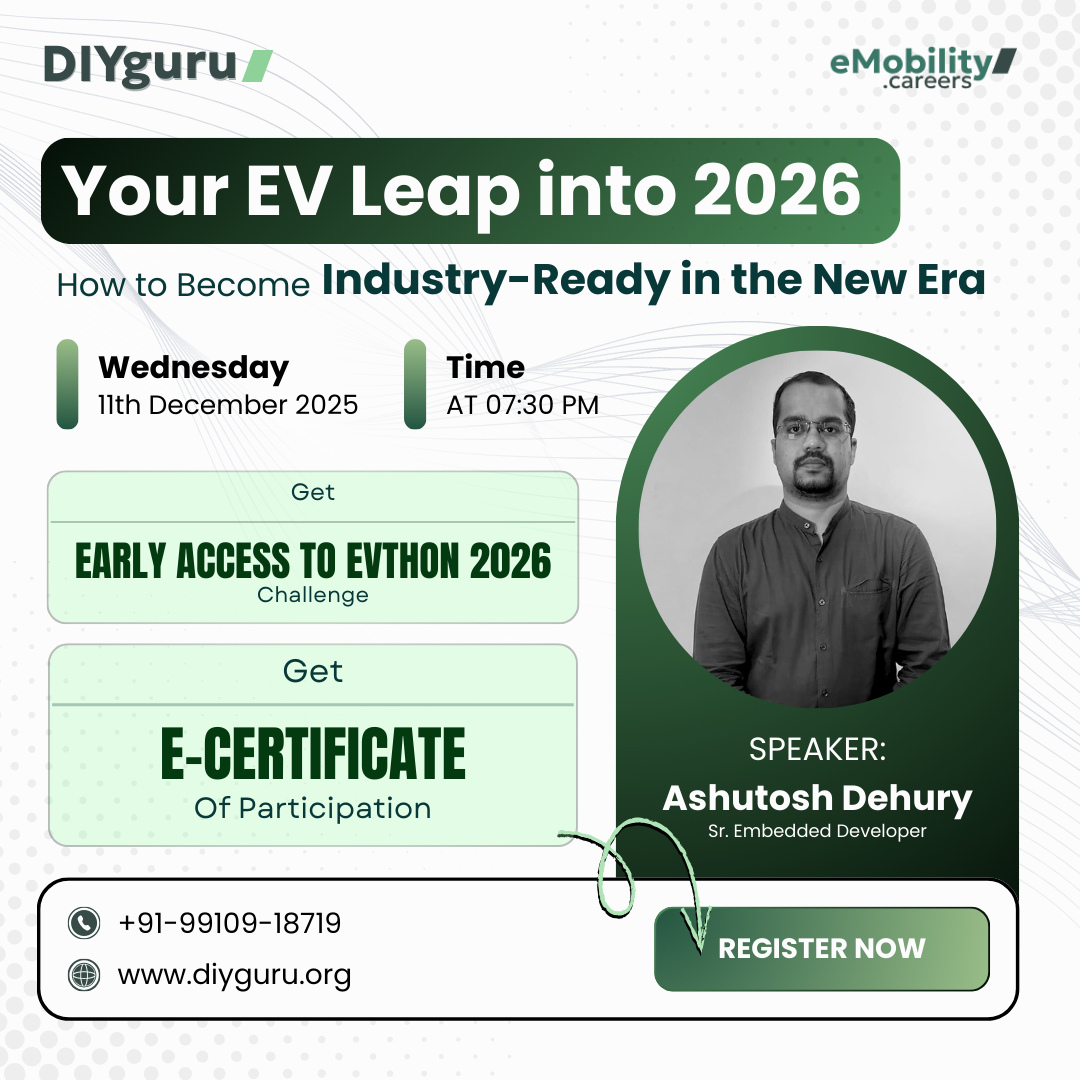
At a Glance
- Title: DIYguru Masterclass – Your EV Leap Into 2026: How to Become EV Industry-Ready in the New Era
- Date: 11th December 2025
- Time: 7:30 PM IST (as per actual session schedule)
- Mode: Online – Live (Completed)
- Host: DIYguru
- Speaker: Ashutosh Dehury – Senior Embedded Developer & EV Systems Expert
Your EV Leap Into 2026: How to Become Industry-Ready in the New Era
As the world accelerates toward electrification, EV skills have become the most demanded technical competencies across automotive, energy, mobility, and manufacturing sectors. DIYguru’s latest masterclass, “Your EV Leap Into 2026,” led by Ashutosh Dehury (Sr. Embedded Developer), provided a deep, realistic, and industry-aligned roadmap for anyone looking to build a long-term, future-proof career in electric vehicles.
This masterclass clarified what the EV industry actually needs, the challenges freshers are facing, and how learners can shape their career path with the right mix of skills, projects, portfolios, and hands-on implementation.
If you’re just starting your EV journey, you can also explore our EV courses for beginners to build strong fundamentals before moving into advanced roles.
What “EV Leap” Truly Means in 2026
The phrase EV Leap represents the shift from learning EV concepts to becoming employable in the EV domain.
And in 2026, this leap is no longer just about knowing batteries or motors — it is about:
 Understanding EV systems end-to-end Implementing real hardware projects Building deep embedded skills Creating industry-level portfolios Knowing job roles + salary expectations + hiring trends
This masterclass highlighted that EV hiring is rising, but EV-ready talent is still limited. Companies are increasingly searching for engineers who understand systems holistically, not individuals who are skilled in just one isolated component.
Industry Trends: Why EV Skills Are No Longer Optional
Ashutosh explained that EV technology is not just “electric cars.” It is a massive ecosystem involving:
-
Automotive OEMs
-
Tier-1 and Tier-2 suppliers
-
Charging infra companies
-
Battery manufacturers
-
Power electronics providers
-
Software & telematics startups
-
Embedded systems companies
The combined demand touches hardware, software, electronics, mechanical, and energy domains.
For those exploring real hiring opportunities in the EV sector, platforms like eMobility Careers regularly publish job roles, salary insights, and industry placement trends.
👉 https://emobility.careers/
Massive shortage of embedded + electronics EV engineers
Companies are hiring aggressively for:
-
BMS development
-
Motor control
-
Power electronics firmware
-
Battery pack engineering
-
CAN/LIN communication
-
Vehicle diagnostics
-
Charging systems
-
Functional safety (ISO 26262)
The masterclass clearly emphasized that your EV Leap must include embedded systems if you want to stay competitive.
To build these highly demanded skills, learners can also refer to DIYguru’s Embedded systems certification program, which covers microcontrollers, CAN communication, and real hardware implementation.
The Core Idea: EV Engineers Must Think Like System Engineers
EV companies do not hire people who only know “the battery side” or “the motor side.”
They want engineers who understand:
-
How different subsystems talk to each other
-
How CAN, UART, I2C, SPI manage communication
-
How BMS monitors safety
-
How power electronics handles current/voltage
-
How control algorithms respond to real-time feedback
This is where most freshers fail — they learn parts of the EV but not the system as a whole.
The masterclass guided learners on how to bridge this gap and become a system-oriented EV engineer.
Deep Dive: Skill Map to Take Your EV Leap (2026 Roadmap)
 1. Electronics Fundamentals
Before learning EV tech, you must master:
-
Ohm’s law, circuits, sensors
-
Microcontroller basics
-
Power electronics fundamentals
-
Switching, inverters, converters
-
Gate drivers, MOSFET/IGBT fundamentals
Without this foundation, advanced EV topics remain incomplete.
2. Embedded Systems (Most Demanded EV Skill)
Ashutosh emphasized this repeatedly:
“The real EV jobs today are in embedded systems.”
Core skills you must build:
-
STM32 microcontroller programming
-
GPIO, Timers, ADC/DAC
-
PWM for motor control
-
Interrupts & real-time programming
-
Communication protocols: CAN, UART, I2C, SPI
-
Embedded C programming
-
FreeRTOS basics
-
Sensor integration
-
Hardware interfacing
These make you employable not only in EVs but also in robotics, IoT, aerospace, and energy systems.
3. EV System Knowledge (Domain Specialization)
You need holistic EV understanding:
-
Battery design & BMS
-
Motor types (BLDC, PMSM, Induction)
-
Motor controllers
-
Thermal management
-
Powertrain architecture
-
Estimation algorithms (SOC, SOH, SOP)
-
Charging standards (CCS, Bharat DC, AC001)
This is where domain meets engineering.
4. Hands-On Projects (Your Portfolio Must Have This)
Ashutosh highlighted that companies reject resumes without hardware projects.
Your EV Leap portfolio should include: CAN-based communication project Battery monitoring system (mini BMS) STM32-based motor control Temperature/voltage sensing FreeRTOS multitasking implementation Data logging + telematics basics
These projects immediately differentiate you from regular applicants.
Engineers who want to explore additional EV learning pathways can also refer to eMobility Academy, which shares resources and EV skill-development content for beginners and professionals.
👉 https://emobility.academy/
 Certification vs. Real Skills — What Companies Actually Check
A major insight from the masterclass:
 Companies do NOT hire based on certificates
 They hire based on your demonstrable skills + projects
Recruiters check:
-
Can you explain how a BMS works?
-
Can you write embedded C code?
-
Can you configure CAN frames?
-
Can you interface sensors to microcontrollers?
-
Can you troubleshoot a motor controller?
Your EV Leap depends on building these competencies.
💼 Career Pathways: Where You Can Work in 2026
The EV job market is expanding across:
🚗 Automotive OEMs
-
Tata Motors
-
Mahindra Electric
-
Hyundai
-
MG Motors
-
BYD
⚡ EV startups
-
Ather Energy
-
Ola Electric
-
River
-
Ultraviolette
🔋 Battery pack manufacturers
-
Log9
-
Exicom
-
Amara Raja
🛠 Hardware + Embedded companies
-
KPIT
-
Bosch
-
Continental
-
Valeo
Every segment is hiring across battery, motor, embedded, and systems engineering.
🧭 How to Take Your EV Leap in the Next 3–6 Months
The masterclass ended with a practical, actionable roadmap:
1. Build Core Electronics + Embedded Skills (0–1 month)
Start with microcontrollers and C programming.
2. Learn EV Architecture (1–2 months)
Battery → Motor → Powertrain → Charging → Safety
3. Build 3–4 Hardware Projects (2–4 months)
Showcase CAN, STM32, sensor integration, FreeRTOS, BMS logic.
4. Build an EV Portfolio (4–5 months)
Upload documentation, GitHub repos, circuit diagrams.
5. Apply for EV Jobs (5–6 months)
OEMs, Tier-1 suppliers, startups.
This is the fastest, most realistic path to becoming industry-ready.
🎁 Freebies from the Masterclass
Participants received:
🎉 Early Access to EVThon
🎓 EV Skills Roadmap PDF
⚙ Project Ideas List
🔌 EV Job Role Handbook
📢 Final Thought: Your EV Leap Starts Now
2026 will be the year of exponential EV growth — but only for those who prepare early.
If you want to enter the EV domain, shift from theory to hands-on learning, and build a strong embedded + EV skillset, this masterclass serves as the perfect starting point.
Your EV Leap is not just a shift in learning.
It is a shift in your career, mindset, and technical depth.
For industry news, EV technology explainers, and updates on charging, batteries, and safety standards, platforms like EV.care provide valuable information.
👉 https://ev.care/