
EV Architecture Overview: Motor Controllers, BMS & Sensor Systems Explained (2026 Guide)
By DIYguru · 11/18/2025 · 7 min read
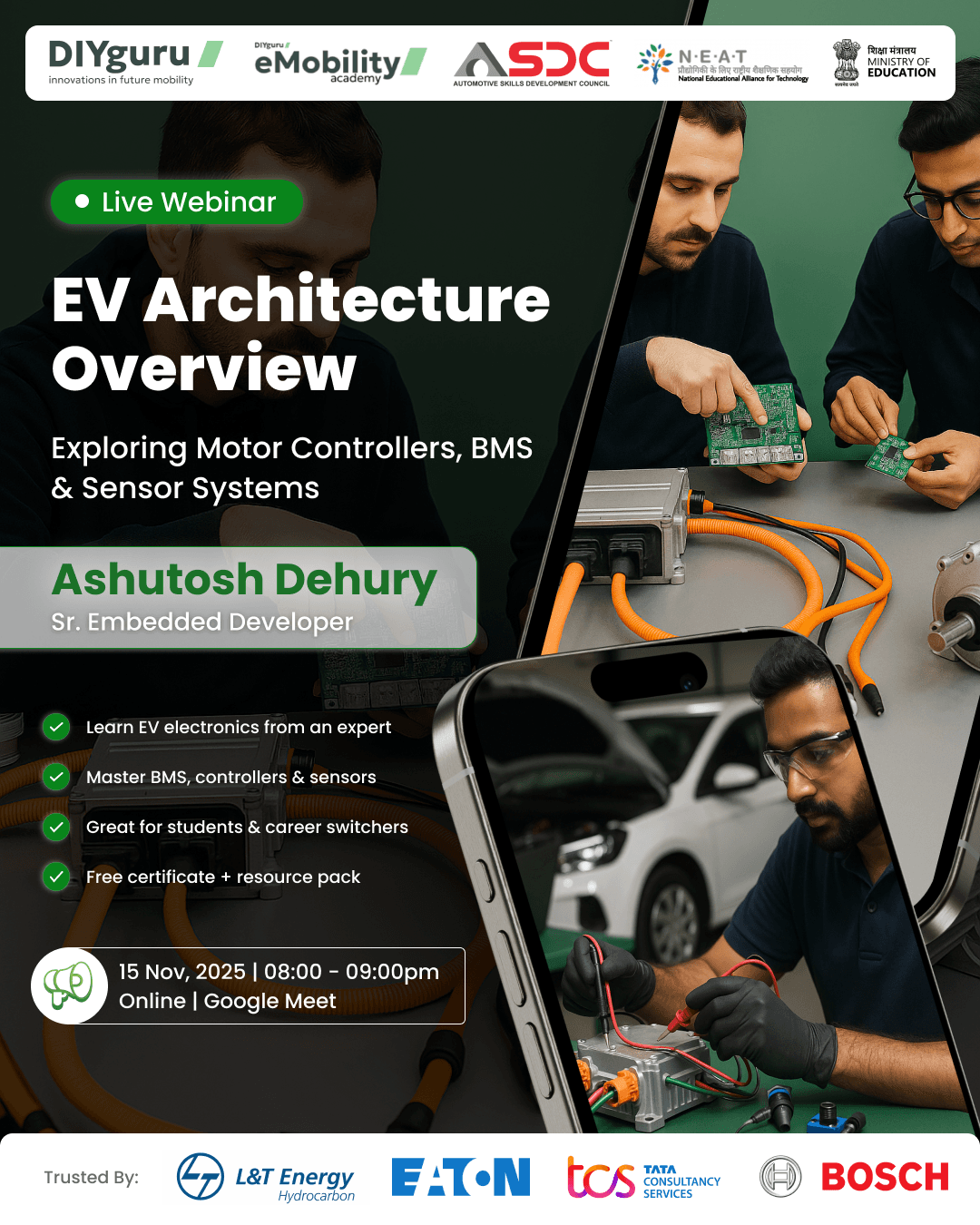
A Complete Breakdown of DIYguru’s EV Architecture Webinar with Ashutosh Dehury The electric vehicle (EV) industry in India and globally is entering a high-growth phase in 2025. However, despite massive demand, companies still face a severe shortage of engineers skilled in BMS, mo
A Complete Breakdown of DIYguru’s EV Architecture Webinar with Ashutosh Dehury
The electric vehicle (EV) industry in India and globally is entering a high-growth phase in 2025. However, despite massive demand, companies still face a severe shortage of engineers skilled in BMS, motor control, embedded systems, firmware, and EV diagnostics.
To address this skill gap, DIYguru hosted a live webinar on EV Architecture Overview featuring Ashutosh Dehury (Sr. Embedded Developer, EV Expert). The session focused on EV electronics, microcontrollers, BMS architectures, sensor systems, and real-world troubleshooting techniques used in the industry.
This article compiles key takeaways, technical concepts, and career insights from the session and video lecture.
EV Market Overview: Why EV Skills Matter in 2025
India’s EV penetration has reached 7% (2024)
This is a massive jump, and the Government of India targets 30% by the end of this decade.
Global competition is intensifying
Companies like Tesla face strong competition from Chinese manufacturers, especially BYD, which began its battery journey in the late 1990s.
Why governments push EV adoption:
-
- High pollution from IC engines (Delhi as an example)
-
- India spends billions in foreign exchange importing fuel
-
- EVs reduce dependency on fossil fuels
The market is growing rapidly — but skilled engineers are lacking, making EV talent extremely valuable right now.
The Skill Gap: Why Engineers Struggle in EV Industry
Ashutosh highlighted that India's engineering curriculum is still outdated:
-
- Students learn 8051 while industries use 32-bit controllers
-
- Very limited hands-on training in BMS, CAN, or EV sensors
-
- OEMs report a shortage of trained manpower in emerging EV domains
High-demand EV Domains (2025–2030):
-
- Battery Management Systems (BMS)
-
- Motor control & motor algorithms (BLDC, PMSM)
-
- Embedded systems (ARM Cortex-M, TriCore, RISC-V)
-
- Software Defined Vehicles
-
- AUTOSAR
-
- ADAS
-
- EV Testing, Validation & Diagnostics
This gap is exactly what the webinar aimed to address.
EV Architecture Explained: Core Components You Must Understand
An EV’s architecture consists of:
✔ Battery Pack & BMS – The brain of the vehicle’s energy system
✔ Motor & Motor Controller – Converts electrical power → mechanical power
✔ Embedded Electronics (70+ ECUs)
✔ Sensor Ecosystem – Temperature, current, Hall, IR, IMU
✔ Communication Protocols – CAN, UART, I2C, SPI
Understanding how these systems communicate and integrate is crucial for any EV engineer.
32-Bit Microcontrollers in EVs: Industry Standard
Ashutosh emphasized that EVs rely heavily on 32-bit microcontrollers, not the outdated systems many students still learn.
Common MCU families used in EVs:
-
- STMicroelectronics (STM32)
-
- NXP
-
- Texas Instruments
-
- Infineon TriCore
Skills Needed:
-
- C & C++
-
- RTOS basics
-
- Interrupts & timers
-
- GPIO, ADC, PWM
-
- Communication protocols
Communication Protocols in EVs: Why CAN is the Most Important
Among all EV communication protocols, CAN Bus is the backbone.
Key concepts engineers must learn:
-
- CAN frame structure
-
- Arbitration ID
-
- Dominant & recessive bits
-
- CAN High & CAN Low
-
- Standard vs Extended CAN
-
- CRC, DLC, SOF
-
- Physical wiring & termination
You cannot work in BMS, motor control, diagnostics, or testing without mastering CAN.
Motor Controller: The Most Common Point of EV Failure
Ashutosh asked the audience which component fails the most:
The answer: Motor Controller.
Reasons for failure:
-
- Overheating
-
- Overcurrent
-
- Phase imbalance
-
- Sensor mismatch
-
- Noise and EMI
-
- Low-quality components
-
- Software algorithm issues
Tools required for diagnosing failures:
-
- Oscilloscope
-
- Logic analyzer
-
- Multimeter
-
- CAN analyzer
Battery Management System (BMS): The Heart of EV Safety
This was one of the most detailed parts of the webinar.
Key BMS parameters:
-
- SOC (State of Charge)
-
- Voltage method
-
- Coulomb counting
-
- OCV
-
- SOC (State of Charge)
-
- SOH (State of Health)
-
- Cell balancing
-
- Active
-
- Passive
-
- Cell balancing
-
- Thermal management
-
- Overcurrent/overvoltage protections
BMS engineers with 3–5 years experience earn 20+ LPA, due to the difficulty of the domain and shortage of talent.
Types of BMS architectures:
-
- Centralized
-
- Distributed
-
- Modular
Distributed BMS offers high redundancy and improved safety — used in modern EVs.
Sensor Systems in EVs
EVs use various sensors for safety, motor control, and energy management.
Important EV Sensors:
-
- Hall sensors (current + position sensing in BLDC)
-
- Temperature sensors
-
- Accelerometer & Gyroscope (MPU6050)
-
- Ultrasonic sensors
-
- IR sensors
Causes of sensor failures:
-
- EMI noise
-
- Moisture
-
- Mechanical vibration
-
- Thermal stress
-
- Calibration drift
Sensors are foundational to ADAS, BMS, motor control, and vehicle safety.
Career Opportunities & Salaries in EV Domain (2025–2030)
High-demand EV job roles:
-
- BMS Engineer
-
- Firmware/Embedded Engineer
-
- Motor Control Engineer
-
- EV Testing & Validation Engineer
-
- Protocol Engineer (CAN, UDS, LIN)
-
- ADAS Engineer
-
- AUTOSAR Engineer
Skills companies expect:
-
- Hands-on debugging
-
- Microcontroller coding
-
- Protocol understanding
-
- Sensor calibration
-
- Use of oscilloscope, logic analyzer
-
- Motor control basics
-
- BMS fundamentals
The shortage of skilled EV talent means this is the best time to switch careers into EV.
DIYguru’s EV Architecture Webinar Benefits (As Announced During Session)
Participants received:
-
- ✔ Free EV Architecture Guide Book
-
- ✔ E-certificate
-
- ✔ Access to DIYguru Entrance Test (DIET)
-
- ✔ Up to 40% scholarship on PG programs
-
- ✔ Community access + learning resources
Conclusion: Why EV Architecture Skills Matter in 2025
EVs are no longer a niche — they are the future of mobility. As India moves toward 30% EV adoption, companies urgently need engineers who understand:
-
- Microcontrollers
-
- BMS
-
- CAN communication
-
- Sensor systems
-
- Motor controllers
-
- Diagnostics & testing
This webinar provided exactly the foundation needed for students, job seekers, and career switchers to enter the booming EV industry.
What is EV architecture?
EV architecture refers to the integrated system of components that power an electric vehicle — including the battery pack, BMS, motor, motor controller, microcontrollers, ECUs, sensors, thermal management system, and communication networks like CAN.
. Why is BMS important in an EV?
The Battery Management System (BMS) monitors the battery’s health, safety, temperature, SOC, SOH, and balancing. It prevents overcharging, overheating, and thermal runaway — which are leading causes of EV fires.
What causes motor controller failures in EVs?
According to industry experts, motor controllers fail most frequently due to overheating, overcurrent, phase imbalance, sensor mismatch, EMI noise, or improper calibration.
Which microcontrollers are used in electric vehicles?
Modern EVs use 32-bit microcontrollers, primarily from STM32, NXP, Texas Instruments, and Infineon TriCore. These are used for BMS, motor control, ECUs, sensors, and safety systems.
What communication protocols should an EV engineer learn?
The most important EV protocols are: CAN Bus (most critical) UART I2C SPI LIN (optional) These are essential for diagnostics, ECU communication, and embedded programming.
What are the best career opportunities in EV systems?
High-demand roles include BMS Engineer, Embedded & Firmware Engineer, Motor Control Engineer, EV Testing & Validation Engineer, CAN Protocol Engineer, AUTOSAR Developer, and ADAS Engineer.
How can I start a career in EV architecture?
Start by learning: - 32-bit microcontrollers - C/C++ programming - CAN communication - BMS basics - Motor control fundamentals Hands-on projects and certification programs (like DIYguru’s PG Programs) accelerate employability.
EV architecture refers to the integrated system of components that power an electric vehicle — including the battery pack, BMS, motor, motor controller, microcontrollers, ECUs, sensors, thermal management system, and communication networks like CAN.
The Battery Management System (BMS) monitors the battery’s health, safety, temperature, SOC, SOH, and balancing. It prevents overcharging, overheating, and thermal runaway — which are leading causes of EV fires.
According to industry experts, motor controllers fail most frequently due to overheating, overcurrent, phase imbalance, sensor mismatch, EMI noise, or improper calibration.
Modern EVs use 32-bit microcontrollers, primarily from STM32, NXP, Texas Instruments, and Infineon TriCore. These are used for BMS, motor control, ECUs, sensors, and safety systems.
The most important EV protocols are: CAN Bus (most critical) UART I2C SPI LIN (optional) These are essential for diagnostics, ECU communication, and embedded programming.
High-demand roles include BMS Engineer, Embedded & Firmware Engineer, Motor Control Engineer, EV Testing & Validation Engineer, CAN Protocol Engineer, AUTOSAR Developer, and ADAS Engineer.
Start by learning: - 32-bit microcontrollers - C/C++ programming - CAN communication - BMS basics - Motor control fundamentals Hands-on projects and certification programs (like DIYguru’s PG Programs) accelerate employability.
https://youtu.be/OfNHGDweDYE Watch Now